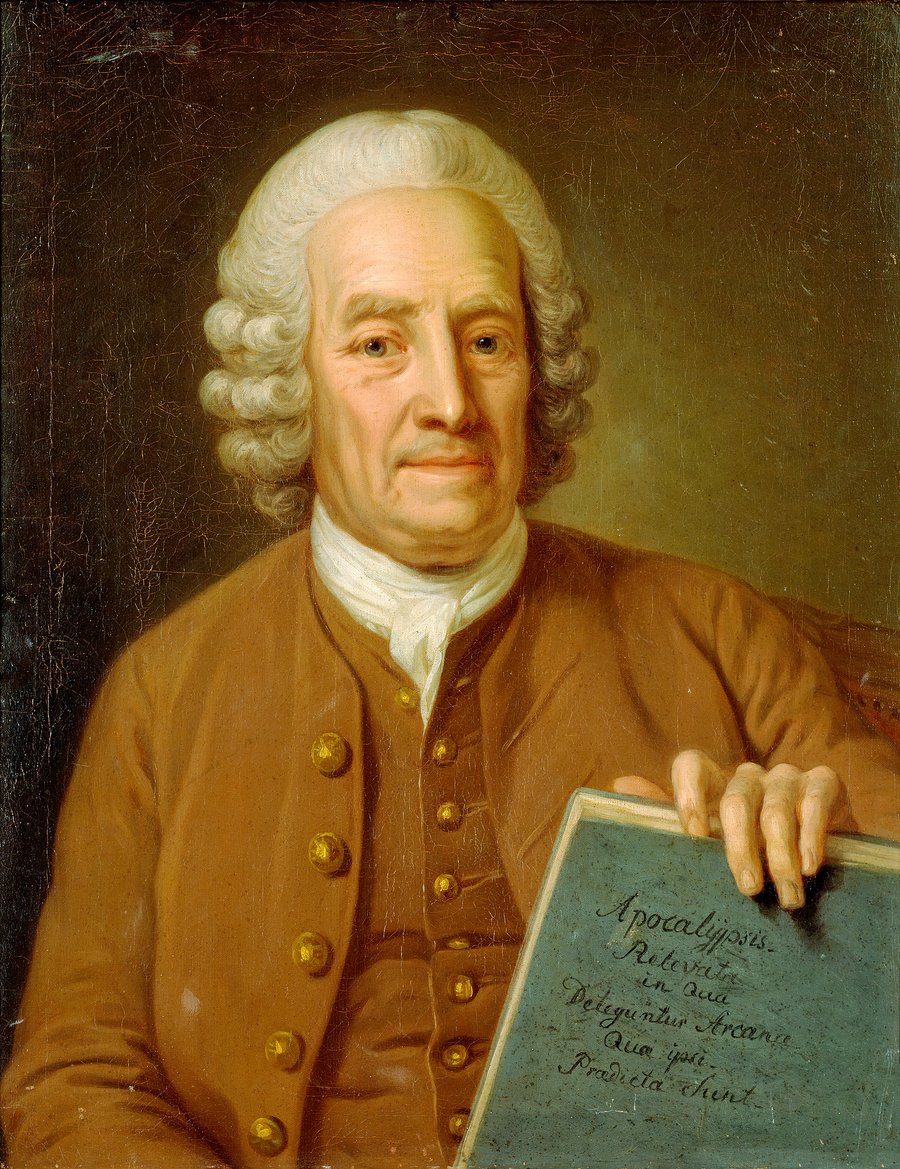
Portrait of Emanuel Swedenborg by Per Krafft the Elder (1766). Nationalmuseum, Sweden — public domain, via Wikimedia Commons.
Emanuel Swedenborg — the man who built the Western afterlife, and filed the first report from another planet.
I. The most influential man you've never heard of
There is a particular kind of historical figure who becomes so successful that he disappears. His ideas win so completely that they stop being his ideas and become simply what everyone assumes. The name detaches from the work, the work dissolves into the culture, and a century later the man is a footnote in a book nobody reads while his sentences are being spoken, unattributed, by people who have never heard of him.
Emanuel Swedenborg (1688–1772) is the clearest case of this in the modern West.
Ask a hundred people at random to describe what happens when you die. A meaningful share of them — churchgoing or not — will say some version of the following: you leave your body, you pass through something like a transition, you're met by people you loved who died before you, you find yourself somewhere that looks and feels real, with landscapes and houses and communities, you are not so much judged by an external authority as sorted according to what you actually loved in life, and the good among you become angels.
Almost none of that is in the Bible. Almost all of it is in Swedenborg.
He was a Swedish mining engineer and member of the House of Nobles who spent the first half of his life as one of Europe's more capable natural philosophers, then spent the second half claiming daily, waking, ongoing conversation with angels, spirits, and the dead — and writing it all down in Latin, anonymously, in London and Amsterdam, at his own expense, for twenty-seven years. He founded no church. He recruited no followers. He never preached a sermon.
And yet: Blake annotated him. Balzac wrote a novel about his doctrine. Baudelaire built a theory of poetry on his correspondences. Emerson gave him a chapter of Representative Men. Kant wrote a whole book attacking him — and in attacking him, took a turn that led toward the Critique of Pure Reason. Strindberg, Yeats, Borges and Miłosz all wrestled with him. Henry James Sr. was a devoted Swedenborgian, which means William James and Henry James grew up inside the system. Helen Keller was a Swedenborgian and wrote a book explaining why. D. T. Suzuki, who introduced Zen to the English-speaking world, translated Swedenborg into Japanese and called him the Buddha of the North. And John Chapman — "Johnny Appleseed" — was not merely planting orchards across the American frontier; he was a Swedenborgian missionary distributing tracts alongside the seeds.
That is an extraordinary spread of influence for a man most educated people cannot place within a century.
This essay argues four things:
- His Heaven and Hell (1758) is the single most important source of the modern Western picture of the afterlife — more than Dante, and vastly more than scripture — and its influence is invisible precisely because it arrived through channels that stripped his name off.
- His obscurity is measurable against a strange fact: a Reconstruction-era Texas court used Swedenborg's name as the self-evident example of a sound mind, without stopping to explain who he was.
- His lesser-known 1758 companion volume on the inhabited planets places him at a hinge in religious history — the point where the demoted gods of paganism, having been converted into angels, get reattached to the celestial bodies they came from, exactly as natural philosophy was emptying those bodies out.
- That book belongs in a lineage running back to Aelius Aristides' Sacred Tales — the last extended first-person diary a pagan left of conversation with his god — and, like it, is best read not as astronomy but as medicine.
II. Two lives in one body
The biography matters, because the standard dismissal — that he was a mystic and therefore a crank — collapses the moment you look at the first fifty-six years.
He was born Emanuel Swedberg in Stockholm, son of Jesper Swedberg, bishop of Skara and court chaplain. The family was ennobled in 1719, and Emanuel took a seat in the Swedish House of Nobles which he used for the rest of his life, contributing to debates on currency, the liquor trade, and Swedish finance.
His day job was Assessor Extraordinary on the Swedish Board of Mines, the Bergskollegium — the state body governing what was then Sweden's economic engine. Not a sinecure. He inspected mines and produced the massive Opera Philosophica et Mineralia (1734), whose volumes on iron and copper were serious technical literature.
Alongside that, he:
- Proposed a version of the nebular hypothesis — the solar system condensing from a rotating cloud — in his Principia (1734), before Kant (1755) and Laplace (1796).
- Produced anatomical work in the Oeconomia Regni Animalis (1740–41) anticipating later findings on the cerebral cortex, functional localisation, the cerebrospinal fluid, and the ductless glands. Neuroscientists have periodically rediscovered these passages with some embarrassment.
- Sketched a flying machine, a submarine, an air pump, and a mechanical carriage.
- Read Latin, Greek and Hebrew, with working command of several modern languages.
- Sat with the Royal Society of Sciences in Uppsala, and was associated with the Royal Swedish Academy of Sciences.
Then, between 1743 and 1745, something happened. He kept a dream journal through it — the Journal of Dreams — one of the strangest documents in European letters, an eighteenth-century engineer recording his own psychological disintegration and reassembly in real time. It culminates in a vision in a London inn in April 1745 in which he reports being commanded to explain the inner sense of scripture and to report what he saw and heard in the world of spirits.
He resigned his post with a pension and wrote nothing but theology for twenty-seven years.
On the "was he insane" question, the difficulty is worth stating honestly rather than resolving cheaply. His claims are extraordinary. His conduct was not. He continued to attend the Diet, manage his money, publish, travel, dine out and correspond widely; acquaintances describe him consistently as courteous, mild and lucid. He was also the subject of several well-attested apparent clairvoyance incidents — most famously his description of a fire in Stockholm while three hundred miles away in Gothenburg in 1759, which Kant himself investigated by letter and reported he could not explain away.
Whatever one concludes, the case does not fit the clinical picture of a man whose reason has been destroyed. Hold that thought; it is why his name ends up in a Texas court record.
III. Heaven and Hell: what it actually says
In the summer of 1758, in London, Swedenborg published five books at once. One was De Coelo et Ejus Mirabilibus, et de Inferno, ex Auditis et Visis — Heaven and Its Wonders and Hell: From Things Heard and Seen. It is his most read and most consequential work, and it remains readable today in a way most eighteenth-century theology does not, because it is written as reportage rather than argument.
Its core claims, most of which broke sharply with the Christianity of his day:
Angels were all once human beings. There is no separately created angelic race. Every angel in heaven and every devil in hell was born as a person on some world, lived a life, and died. This single doctrine does more work than any other in the system.
Nobody is sent to hell. God condemns no one. After death each person gravitates to the community whose ruling love matches their own. The damned are in hell because it is the only place they can bear; removed from it they would be in agony. Hell is self-selected.
Death is continuous with life. You wake in the world of spirits — an intermediate state — often without realising you have died, with the same memory, personality and appearance. Those who died earlier come to meet you. There follows a period in which the outer social self falls away and the inner ruling love is exposed.
Heaven is a real place with real content. Not a static beatific vision but landscapes, dwellings, gardens, cities, occupations and work. Angels marry, live in communities, and have functions. Time and space there are not extension but states — proximity is similarity, distance is difference.
Heaven is shaped like a person. The whole of heaven composes a single human form, the Maximus Homo or Grand Man, each community corresponding to an organ or faculty. Hold onto this one. It is the key to everything in sections VI and VII.
Correspondences. The natural world is a projection of the spiritual world, feature by feature, and scripture is written throughout in that code.
IV. The transmission: how this became everyone's afterlife
The claim that Heaven and Hell is the source material for most Western depictions deserves argument rather than assertion, because there is an obvious rival — Dante — and an obvious objection: ordinary people don't read Latin theology.
Three parts.
First, the distinctive content is his, not scripture's and not Dante's. The Bible says remarkably little about the afterlife's interior. Sheol is a shadowy nothing; the New Testament gives a resurrection, a judgment, a kingdom, a lake of fire, and some parables — but no tour, no geography, no reunion with relatives, no description of what the blessed do. Dante gives geography in abundance, but his is a juridical structure: sinners placed by an external justice in punishments matched to offences, and his angels are a separate created order in the Dionysian hierarchy. The specifically modern picture — self-sorting rather than sentencing, reunion with the dead you loved, the newly dead not realising they've died, ordinary life continuing in a recognisable landscape, and above all the dead becoming angels — is Swedenborgian in origin and appears in no major earlier Christian source.
Second, there is a documented transmission chain.
- The New Church (Church of the New Jerusalem), organised in London in 1787 and spreading fast in America. Small in membership, disproportionate in publishing; it flooded the nineteenth-century Anglophone world with cheap English editions.
- The Romantics and the literary elite — above all Blake, whose engravings and poetry carried Swedenborgian structure into art, and Emerson, who made him one of six representative men of humanity.
- American Spiritualism, which exploded after 1848 and took Swedenborg as its principal precursor. Andrew Jackson Davis, the "Poughkeepsie Seer" and Spiritualism's leading systematiser, worked directly in his frame. Spiritualism was a mass movement, and it carried the Swedenborgian afterlife into millions of ordinary parlours.
- Consolation literature, above all Elizabeth Stuart Phelps's The Gates Ajar (1868), a bestseller in a bereaved post–Civil War America. Heaven as a homelike place where families reunite and life continues — Swedenborg's heaven with the citation removed. Arguably the single largest transfer event.
- Twentieth-century film and popular fiction, which inherited the Phelps/Spiritualist picture as simply what heaven is.
Third, the fingerprints are diagnostic. When a modern eulogy says a dead child "has her wings now," it reproduces the doctrine that human beings become angels — a specifically Swedenborgian innovation, rejected by Catholic and Reformed theology alike, in which angels are a distinct order of creation. When a story shows the newly dead wandering, confused, not yet aware they have died, that is Swedenborg's world of spirits. When C. S. Lewis argues in The Great Divorce that the doors of hell are locked on the inside, he is restating Swedenborg's central thesis, whatever his intent.
The honest qualification: influence is not authorship. Folk belief in reunion with the dead is older than any book, and Swedenborg worked with materials already in the culture. But he is the one who assembled them into a coherent, detailed, systematic account — and it is his assembly the West is still using.
V. Swedenborg in a Texas courtroom: Denson v. Beazley
There is a measure of a man's cultural reach more reliable than a list of famous admirers: whether an ordinary professional in a provincial setting can invoke his name and expect to be understood without explanation.
By that measure, Swedenborg was once a household name in America.
The case. Denson v. Beazley reached the Supreme Court of Texas from the Probate Court of Polk County, Texas, during Reconstruction. The testator was Colonel Hamilton Washington, a Virginian who had come to Texas from Mississippi some thirty years earlier with his sister, Mrs. Mary H. Beazley, her blind husband, and their children. He had invested his sister's money in Polk County land, held title in his own name, said openly he intended it all to go to her, and in 1860 executed a will doing exactly that.
In 1868, in the ruin of the war, he sold his plantation to a Colonel W. B. Denson for sixteen thousand dollars on credit, in fourteen notes. Denson moved into the house with his family and his brother-in-law. Washington took to his bed. Within roughly six months of meeting Denson, and days after taking to that bed, Washington executed a new will forgiving most of the notes — the bulk of the estate — to Denson, with a codicil instructing his executors never to press him. The sister got the remainder.
The jury threw the 1868 will out. Denson appealed.
The passage. The Texas Supreme Court reversed, and the reason is what puts Swedenborg in the record. The trial judge had charged the jury with a definition of insanity ending in this test: that the presence or absence of delusion is the true test of the presence or absence of insanity.
Justice Walker called this "learned sophistry," and then wrote the sentence that matters:
Tried by such a metaphysical or psychological test, Emanuel Swedenborg, John Wesley, Martin Luther, Joan of Arc, Joseph Addison, and the author of Rasselas, Napoleon Bonaparte, and hundreds more of the greatest and soundest minds which ever existed on earth, must be declared insane.
Read that list. Swedenborg is named first — ahead of Luther, ahead of Joan of Arc, ahead of Napoleon. The court then enumerates the delusions in question: people no longer believe in visions and apparitions, no longer throw inkstands at the devil (Luther), no longer credit that a wandering palmist could foretell the destiny of a creole girl who became the wife of one of the greatest men who ever lived (Napoleon and Joséphine). The point is that men of unquestioned soundness have held beliefs their own era treats as impossible, and that a legal test converting unusual belief into incapacity would empty the world of competent testators. Judgment set aside, cause remanded.
Justice Evans dissented at length, marshalling the medical jurisprudence of the day — Ray, Redfield, Taylor, Wharton and Stillé — and arguing the real issue was not delusion but undue influence: an old, sick, isolated man, separated from his family, with only Denson and Denson's brother-in-law at his bedside, talking loudly at meals about the crop failing, bringing him a cotton twig with two worms on it so that he would say "It is all gone! all gone!"
Why it matters here. Three things.
One — direct evidence of Swedenborg's penetration into ordinary American consciousness. A judge in East Texas in the early 1870s reached for his name as the first and most obvious example of a great mind who reported impossible things, and expected every lawyer in the room to nod. He did not gloss it. That is the usage pattern of a genuinely famous name. Compare the situation today.
Two — it locates him inside a real and continuing legal problem. American courts have repeatedly had to decide whether religious and visionary belief can be evidence of incapacity or fraud. The line Walker defends here — that a belief is not legally delusional merely because the majority finds it impossible — runs forward to United States v. Ballard, 322 U.S. 78 (1944), holding that a jury may examine the sincerity of a religious claim but never be asked to decide its truth.
Three — an accident of literary history. "The author of Rasselas" is Samuel Johnson, and the most famous episode in Rasselas is the mad astronomer who believes he governs the weather and the motion of the planets. Walker, arguing about delusion, names Swedenborg and Johnson's planet-controlling astronomer in the same breath — apparently without knowing that Swedenborg had written a book about the inhabitants of the planets.
(Sourcing: the opinion is on CourtListener, opinion ID 5075584. The bench composition — Walker, J.; Evans, P.J. — places it in the Reconstruction-era Texas Supreme Court, c. 1871–72.)
VI. Earths in the Starry Heavens
The other book Swedenborg published in London in that same summer of 1758 is short — seventy-two pages in the first Latin edition — and carries one of the longest titles of the century:
De Telluribus in Mundo Nostro Solari, quae vocantur Planetae, et de Telluribus in Coelo Astrifero, deque illarum Incolis, tum de Spiritibus et Angelis ibi; ex Auditis et Visis
Concerning the Earths in Our Solar System, Which Are Called Planets, and Concerning the Earths in the Starry Heaven, and Concerning Their Inhabitants, and Likewise Concerning the Spirits and Angels There; From Things Heard and Seen.
It reached English in 1787 and has circulated since as Earths in the Universe, The Worlds in Space, and Life on Other Planets.
The content is what the title says. Swedenborg reports being taken by angels to converse with the spirits of the inhabitants of Mercury, Venus, Mars, Jupiter, Saturn and the Moon — every body then known — and then further out, to five worlds orbiting other stars.
He describes their appearance, clothing, houses, government, speech and religion. The Mercurians are consumed with the acquisition of knowledge and despise material things; they represent memory. The Jovians live in tribal families under no coercive government, walk on their palms as well as their feet, and have a facial speech. The Martians are among the best of all, speaking with the face and eyes so that dissimulation is impossible. Almost universally these peoples are non-materialistic, unwarlike, high-minded and closer to God than the inhabitants of our earth, who come off badly — greedy, quarrelsome, obsessed with possessions.
Two structural points make it more than a curiosity.
The Grand Man. The planets are not a random tour. Each world and its inhabitants correspond to a faculty or organ of the Maximus Homo. The solar system is an anatomy. Same doctrine as in Heaven and Hell, extended outward to the sky.
Why Christ came here. He addresses the obvious problem of a plural universe head-on: if there are countless inhabited worlds, why the Incarnation on this one? His answer is that the Lord is God of the whole universe, not of one planet, and that He was born here because writing exists here. Only on our earth could the Word be recorded on tablets, parchment, paper and finally print, preserved for posterity and circulated across a globe whose inhabitants travel and communicate. Earth is not the most spiritual world. It is the world with the printing press.
The obvious and fatal objection, stated plainly: Swedenborg's solar system stops exactly where eighteenth-century astronomy stopped. He describes inhabitants of every planet known in 1758 and says nothing of Uranus (1781) or Neptune (1846). A visionary tour of the solar system containing precisely the planets in the almanac is, at minimum, a serious evidentiary problem. I'm not going to pretend otherwise, and I'll come back to it.
VII. The societal map: gods to angels to planets
Here is the position he occupies, and it is genuinely strange.
Stage one: the gods are demoted, not deleted. The move from polytheism to monotheism was not, historically, a matter of erasing the other gods. It was a matter of subordinating them. The Hebrew Bible preserves the seam plainly. Psalm 82 opens with God standing in the divine council, among the gods, pronouncing judgment on them — and ends by sentencing them to die like men. Deuteronomy 32:8–9 has the Most High apportioning the nations according to the number of the divine beings, with Israel as YHWH's own portion. The gods of the nations are not denied. They are ranked, stripped of autonomy, and reclassified as servants.
Stage two: the servants get names, and the names come from Persia. Israel's angelology thickens dramatically in and after the Persian period. Before the exile, God's messengers are largely anonymous. In Daniel we suddenly get Gabriel and Michael by name, national guardian-princes, and a structured celestial hierarchy. The rabbis noticed and recorded it: the Jerusalem Talmud states outright that the names of the angels came up with them from Babylon. The Zoroastrian system offers close structural parallels — the Amesha Spentas, the yazatas (a word meaning, in effect, beings worthy of worship), cosmic dualism, final judgment, resurrection.
(The scholarly dispute over how much moved in which direction is real and unresolved, largely because the Avestan texts are attested late even though the tradition is old. What is not in dispute is that after Persia, Judaism — and through it Christianity — possessed a populated, hierarchical, named angelic order it had not previously had.)
Stage three: the demoted gods are reattached to the planets. Usually forgotten. Late antique and medieval cosmology did not leave the sky empty. Each planetary sphere was governed by an intelligence — Aquinas's separated substances, the movers of the spheres; the Dionysian hierarchy of nine angelic orders; and in the magical tradition an explicit assignment of archangels to planets. Agrippa's Three Books of Occult Philosophy (1533) sets it out: Michael to the Sun, Gabriel to the Moon, Raphael to Mercury, Anael to Venus, Samael to Mars, Sachiel to Jupiter, Cassiel to Saturn. The pagan planetary gods had been converted, not evicted. Mercury the god of communication and knowledge became Raphael the intelligence of the sphere of Mercury. The furniture was rearranged. The tenants stayed.
Stage four: the scientific revolution evicts them. Between Copernicus (1543) and Newton (1687) the planets became masses. They move by gravitation, not because an intelligence loves God and turns its sphere in imitation. Newton kept God in the General Scholium; he did not keep the planetary intelligences, and nobody needed them again. By the 1750s the sky was, for the first time in Western history, empty of persons.
Stage five — Swedenborg — the planets are repopulated. In 1758, at the precise moment natural philosophy has finished clearing the heavens of intelligences, a Swedish mining engineer publishes a book putting people back on every one of them.
And note what kind of people. Not gods. Not the created angelic orders of Dionysius and Aquinas. Human beings, and the spirits of human beings who lived and died on those worlds. This is where his doctrine that all angels were once people does its real work. The chain of demotion runs one full step further than it ever had:
gods → angels → the dead
The beings who once received sacrifice, and were then reduced to messengers, are now reduced again — to deceased persons from other planets, organised by what they loved. Swedenborg is simultaneously the most radical demoter in the sequence and the man who re-enchants the solar system. He empties the sky of divinity and refills it with biography.
One detail deserves attention rather than either dismissal or overclaiming. His Mercurians are the faculty of memory and knowledge. The classical Mercury — Hermes, Thoth, Nabu — is precisely the god of knowledge, writing and communication. The assignment matches the ancient one exactly. The disciplined reading is that this is inheritance, not confirmation: the Mercury-mind correspondence was ambient in the culture he breathed, present in astrology, alchemy and Renaissance magic, and he did not need to travel to Mercury to arrive at it. But it demonstrates the continuity of the map. The functional domains of the old planetary gods survive intact through the angelic period and into Swedenborg's spirit-populations, under three different theological regimes. The names change every few centuries. The assignments do not.
VIII. The first contactee — with the overclaim killed first
Let me kill a tempting overstatement immediately, because it is the sort of thing that gets a thread dismissed in one reply.
Earths in the Starry Heavens is emphatically not the first book about extraterrestrials. The idea is ancient and the bibliography is long:
- Lucian of Samosata, A True History (c. AD 175) — a voyage to the Moon and a war between the Moon-people and the Sun-people.
- Nicholas of Cusa, De Docta Ignorantia (1440) — inhabitants of the Sun and Moon, on theological grounds.
- Giordano Bruno, De l'infinito, universo e mondi (1584) — countless worlds, countless inhabitants. He burned for it in 1600.
- Johannes Kepler, Somnium (written 1608, published 1634) — lunar inhabitants derived rigorously from actual lunar astronomy; usually called the first work of science fiction.
- Francis Godwin, The Man in the Moone, and John Wilkins, The Discovery of a World in the Moone, both 1638.
- Cyrano de Bergerac, The States and Empires of the Moon (1657) — extended conversations with lunar inhabitants.
- Fontenelle (1686), a genuine bestseller; Huygens, Cosmotheoros (1698); and Kant's Universal Natural History (1755), three years before Swedenborg, speculating that beings on distant planets might be more perfect than we are.
By 1758 the plurality of worlds was not a fringe notion. It was a fashionable one.
Swedenborg's innovation is not the claim. It is the evidentiary basis. Every previous writer worked in one of two modes. Either fiction — Lucian, Kepler, Godwin, Cyrano, all of whom framed the voyage as a tale, a dream or a satire and expected to be read that way — or inference: the universe is vast, God does nothing in vain, therefore other worlds are surely inhabited. Cusa, Bruno, Fontenelle, Huygens and Kant all argue from probability. None claims to have been there.
Swedenborg argues from testimony, in the first person, as non-fiction, under the sober heading ex auditis et visis — from things heard and seen. He does not reason that Martians probably exist. He reports that he met them and tells you what they said, in the same documentary register he had used for twenty years to report on copper smelting.
So the precise claim, and the only one worth defending: Swedenborg did not write the first book about extraterrestrials. He wrote the first one that was neither fiction nor inference — the first sincere non-fiction eyewitness report of contact with beings from other worlds. He invented contact literature: the first-person report, the moral comparison, the spiritually superior visitor, delivered as testimony rather than as argument or art.
That single move creates a genre, and the lineage is continuous:
- Kant's reaction, Dreams of a Spirit-Seer, Illustrated by Dreams of Metaphysics (1766), a sustained and sarcastic attack — but the sting is that Kant recognised his own speculative metaphysics in the target. If we cannot verify Swedenborg's spirits, on what grounds do we verify anything beyond possible experience? The critical turn follows.
- Nineteenth-century Spiritualism produced planetary mediums as a standard subtype. Flournoy's From India to the Planet Mars (1900) documents Hélène Smith, who produced a Martian language, script and landscapes.
- Theosophy built planetary and root-race schemes on which later occult cosmology depends.
- Edgar Cayce's planetary sojourns are the closest twentieth-century structural analogue: souls between incarnations dwelling on and shaped by specific planets, each imparting a specific faculty. Swedenborg's Grand Man doctrine in an American trance-reading idiom.
- The 1950s contactees — Adamski's benevolent Venusians, Van Tassel, Fry — reproduce the template with astonishing fidelity: the visited species is peaceful, spiritually advanced, non-materialistic, and appalled at our violence and greed. When 1950s Venusians warn us about nuclear weapons, they perform the office Swedenborg's Mercurians performed in warning about our attachment to worldly things.
- Modern channelled ET material — Pleiadians, Arcturians, the whole category — is the same genre with the serial numbers filed off.
Which returns us to the map. The beings who were gods, then angels, are here reattached to planets and described in the language of angels — and two centuries later the same reports would be filed under a new heading with the beings redescribed as extraterrestrials. A fourth translation:
gods → angels → the dead → aliens
Same sky. Same intermediaries. Same function: a class of intelligent beings above us, associated with the celestial bodies, whose superior knowledge indicts our conduct. Only the vocabulary of the age changes.
IX. The Sacred Tales precedent: divine communication as medical literature
There is one more shelf this book belongs on, and putting it there resolves what the book is actually for.
The last pagan diarist of a god.
In the second century AD, Publius Aelius Aristides (117 – after 180) was among the most celebrated orators in the Roman Empire, a leading light of the Second Sophistic, praised by Philostratus as the most deeply versed in his art of all the sophists. In late 143, travelling to Rome at the peak of his ascent, he collapsed into an illness he never fully shook off. He turned to Asclepius, the paramount healing god of the ancient world, and went to the great Asclepieion at Pergamon — where the sick slept in the sacred precinct, a practice called incubation, and received prescriptions from the god in dreams.
He stayed roughly two years in the period he calls the kathedra, and remained in the god's service for decades. And the god gave him the instruction that is the reason we have any of this: Asclepius commanded him to keep a written record of the dreams. Aristides obeyed, kept the diary for years, and late in life worked it into the Hieroi Logoi — the Sacred Tales — a first-person, book-length account of sustained two-way communication with a named deity.
What the god prescribed was medicine, and strange medicine: fasting, peculiar diets, bloodletting, enemas, induced vomiting, abstention from bathing, and most notoriously bathing in rivers in midwinter. His physicians deferred. Asclepius also advised on his career, prescribing speeches, poems and public declamations as therapy. The distinction between treating the body and treating the mind is simply not operative in the text.
Now the qualification, because the strong version will not survive contact with a classicist. Aristides is not literally the last pagan to claim conversation with a god. Iamblichus defended theurgic contact in De Mysteriis around AD 300. Julian the Apostate reported divine encounters in the 360s. Marinus's Life of Proclus records the philosopher's visions of Athena in the fifth century.
The defensible claim is narrower and more interesting: Aristides is the last pagan to leave an extended, first-person, diaristic record of ongoing personal communication with a named god, written by himself, in his own name, and preserved. Proclus's visions reach us secondhand through a disciple's hagiography. Julian's appear as asides inside polemic. Iamblichus theorises the practice rather than journalling it. Aristides is the last one to keep the notebook.
And that is exactly the point of comparison, because what is rare in both cases is not the experience. It is the documentary form.
The structural parallel.
| Aristides | Swedenborg | |
|---|---|---|
| Standing | Foremost orator of the Empire | Assessor of Mines, House of Nobles, published natural philosopher |
| Trigger | Physical collapse, 143 AD | Crisis and visions, 1743–45 |
| The command | Asclepius orders him to record the dreams | The 1745 vision orders him to write what he sees and hears |
| Working document | Dream diary kept for years | Journal of Dreams, Spiritual Diary |
| Public work | Hieroi Logoi, composed decades later from the notes | theological corpus 1749–71, drawn from the diaries |
| Output of the contact | A regimen for the body | An anatomy of the cosmos |
| Modern verdict | Hypochondriac, neurotic | psychotic, epileptic, schizophrenic |
Between them stand sixteen hundred years in which Christian visionaries wrote in a different key. Hildegard of Bingen, Julian of Norwich and Teresa of Ávila all recorded visions, but within an approved ecclesial frame, vetted by confessors, and directed at the one God rather than a named subordinate deity who answers back with practical instructions. Hildegard is the closest hinge case and a telling one — her visions coexisted with the Physica and Causae et Curae, works of practical medicine and natural history. The visionary who produces a medical text is a recurring type, not an anomaly.
Swedenborg is the first man since Aristides to resume the pagan documentary posture in full: keep the notebook, name the interlocutors, publish the transcript as fact.
Where Earths in the Starry Heavens actually belongs: mind, body, soul
Read as astronomy, De Telluribus is indefensible and the Uranus problem sinks it. Read as what it structurally is, it is something else entirely: a medical text.
Recall the governing doctrine. Heaven is the Maximus Homo, the Grand Man — the whole spiritual world composing a single human form, every community corresponding to an organ or faculty. Earths in the Starry Heavens extends that body outward to the sky. Each planet and its inhabitants is a faculty of a cosmic organism: Mercury is memory and knowledge; the other worlds their own offices, temperaments and functions. The book is not a survey of real estate. It is an anatomy chart, and the patient is the universe.
Placed there, it joins a long and thoroughly documented medical tradition:
- Melothesia, the zodiac man, was standard clinical equipment. Every medieval physician carried a folding almanac showing the "vein man," signs governing body parts — Aries the head down to Pisces the feet — and planets governing organs. You did not bleed a limb while the Moon was in its ruling sign. Not fringe belief: licensed practice, taught in universities as iatromathematics.
- Macrocosm and microcosm, the doctrine that the body is a scale model of the cosmos and the cosmos a body, is the organising principle of Renaissance medicine. Robert Fludd's Utriusque Cosmi (1617–21) is literally titled for the two cosmoses, greater and lesser. Paracelsus built his pharmacology on correspondences between celestial and bodily realms.
- Hildegard's Causae et Curae derives its physiology from vision and reads the humours cosmologically.
And Swedenborg is not borrowing this from outside. He was a working anatomist. Before the visions he spent years on the Oeconomia Regni Animalis (1740–41), dissecting and reading his way through the brain, the cortex, the cerebrospinal fluid, the lungs and the ductless glands, producing observations later neuroscience partly vindicated. When such a man tells you heaven is shaped like a body and each community is an organ, he is not reaching for a poetic figure. He is using his professional vocabulary. The Grand Man is an anatomist's cosmology, written by an anatomist.
His psychology is explicitly tripartite too. Swedenborg's human being exists on three discrete degrees — natural, spiritual and celestial — connected not by continuity but by correspondence. That is a mind-body-soul architecture in the strict sense, and Earths in the Starry Heavens is the outermost chart of it: the soul-level cartography of a system whose lower levels he had already mapped with a scalpel.
What this reframing does and does not buy. There is a cheap version of this move and it should be refused. Reading De Telluribus as anatomy does not rescue the eyewitness claim. If the book is a factual report of visits to Mercury, the absence of Uranus and Neptune remains a serious evidentiary problem, and no amount of symbolic reading dissolves it. He presented the work as fact and must be held to that. What it does buy is an explanation of the book's structure — why it is organised by faculty rather than distance, why the inhabitants are moral types rather than biological species, why every world is characterised by what it is good at, and why our own earth comes out worst. Those are the design features of a diagnostic chart, not a travelogue. It also explains the otherwise baffling detail that his Mercurians govern memory and knowledge — the classical domain of Mercury, Hermes, Thoth and Nabu. He is filling in a chart whose column headings the tradition had already written.
X. The Latin problem
A final reason for the obscurity, more mundane than the others but probably decisive.
He wrote everything in Latin and published almost all of it anonymously. He was writing for the international learned republic of the mid-eighteenth century at exactly the moment that republic was switching to the vernacular. Within a generation his intended audience no longer existed in the form he had addressed.
The corpus is enormous. Arcana Coelestia alone runs to eight volumes and roughly 4,500 pages in the first Latin edition (1749–56). Eighteen theological works appeared in his lifetime. Behind those sit the manuscripts: roughly 20,000 pages, donated after his death by his heirs to the Royal Swedish Academy of Sciences in Stockholm, where they remain — one of the largest surviving eighteenth-century manuscript collections in existence, and among the very few to have served as the basis for a new Christian church. UNESCO added the Emanuel Swedenborg Collection to the Memory of the World Register in 2005, in Sweden's first designation. Further manuscripts are at the Diocesan Library in Linköping.
Much of it has never been translated into English. Substantial portions of the scientific and philosophical works, the drafts, the indexes and parts of the Spiritual Diary remain accessible only in Latin or in nineteenth-century Latin editions produced by J. F. I. Tafel, who died in 1863 before finishing. The Swedenborg Foundation's New Century Edition is the serious modern translation effort, and high-resolution scanning of the Stockholm archive has been underway since 2013.
The practical consequence: a man whose ideas reshaped the Western imagination has a body of work most of which no researcher without Latin can read.
XI. Conclusion
Swedenborg is a test case for how influence actually propagates. He founded nothing, led nothing, preached to nobody. He wrote in a dying language, anonymously, for a shrinking audience, about experiences most of his contemporaries thought were symptoms. And the picture of the afterlife he assembled is now the default picture in a civilisation that has forgotten his name — reaching ordinary people not through his books but through Spiritualist parlours, consolation novels, Romantic poetry and eventually film, each step stripping the attribution a little further.
The Texas court record is the clearest available measurement of what has been lost. In a Polk County will contest, a judge reaching for the most obvious example of an indisputably great mind who reported impossible things named Swedenborg first, ahead of Luther and Joan of Arc, and did not stop to explain who he was. That is what fame looks like from the inside. A hundred and fifty years later the same sentence would need a footnote.
And Earths in the Starry Heavens, the book that made him a laughingstock, turns out to be the most consequential thing in the pile — not as astronomy, which it plainly is not, but as the founding document of a genre and as the outermost chart of a medical cosmology. It sits at the exact hinge where the old gods, having been converted into angels and then evicted from the sky by Newton, come back down as persons, attached to the planets they always belonged to, described by a man using the only vocabulary his century gave him.
And the form is older than either name. Sixteen centuries before Swedenborg, a sick orator slept in a precinct at Pergamon, was told by Asclepius to keep a notebook, and obeyed for the rest of his life — producing out of years of dreams a map of a body. Swedenborg was told the same thing in a London inn in 1745, kept the same kind of notebook, and produced out of it a map of a body too, one that happened to be the size of the universe.
The interlocutor changes name from age to age: god, angel, spirit, alien. The instruction is always the same one.
Write it down.
Sources
Primary — Swedenborg
- De Coelo et Ejus Mirabilibus, et de Inferno, ex Auditis et Visis. London, 1758. (First English edition London, 1778.)
- De Telluribus in Mundo Nostro Solari, quae vocantur Planetae… London, 1758, 72 pp. (First English edition London, 1787.)
- Arcana Coelestia. London, 1749–56, 8 vols.
- Oeconomia Regni Animalis. 1740–41.
- Journal of Dreams, 1743–44.
Legal
- Denson v. Beazley, Supreme Court of Texas (Reconstruction era, c. 1871–72), on appeal from the District Court, Polk County. Walker, J., lead opinion; Evans, P.J., dissenting. CourtListener opinion 5075584.
- United States v. Ballard, 322 U.S. 78 (1944).
- Redfield, The Law of Wills, part 1 — the authority relied on throughout the Denson opinions.
Aristides and visionary medicine
- Aristides, Aelius. Hieroi Logoi. Trans. C. A. Behr, P. Aelius Aristides: The Complete Works (Leiden, 1981).
- Behr, C. A. Aelius Aristides and the Sacred Tales. Amsterdam, 1968.
- Downie, Janet. At the Limits of Art: A Literary Study of Aelius Aristides' Hieroi Logoi. Oxford, 2013.
- Petsalis-Diomidis, Alexia. Truly Beyond Wonders: Aelius Aristides and the Cult of Asklepios. Oxford, 2010.
- Edelstein & Edelstein. Asclepius: A Collection and Interpretation of the Testimonies.
- Fludd, Robert. Utriusque Cosmi… 1617–21. Hildegard of Bingen, Physica; Causae et Curae.
Plurality of worlds
- Roy-Di Piazza, Elisabeth. "'Ghosts from other planets': plurality of worlds, afterlife and satire in Emanuel Swedenborg's De Telluribus (1758)." Annals of Science, 2020.
- Crowe, Michael J. The Extraterrestrial Life Debate, 1750–1900.
- Kepler, Somnium (1634); Cyrano de Bergerac (1657); Fontenelle (1686); Huygens, Cosmotheoros (1698).
Reception and influence
- Grandin, Karl, ed. Emanuel Swedenborg — Exploring a "World Memory". Swedenborg Foundation.
- Flournoy, Théodore. From India to the Planet Mars. 1900.
- Phelps, Elizabeth Stuart. The Gates Ajar. 1868.
- Emerson, R. W. "Swedenborg; or, the Mystic," in Representative Men. 1850.
- Kant, Immanuel. Träume eines Geistersehers. 1766.
- UNESCO Memory of the World Register: Emanuel Swedenborg Collection (2005).