Hathor’s reference library: the crowns, weapons, armour, chariots, regalia, objects, landscapes and people that the remakes, the animations and the 3D scenes are assembled out of. Every piece was rendered on our own servers from the record kept with it, and where a museum photograph on Wikimedia Commons was the reference, that file, its licence and its photographer are credited under the render.
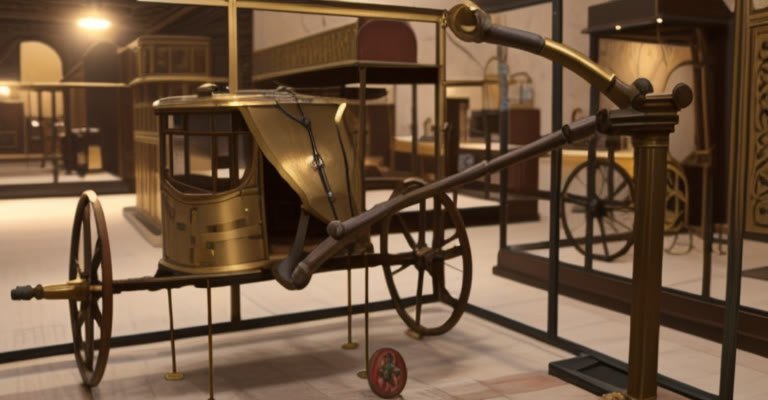
Ceremonial chariot of Tutankhamun
New Kingdom, 18th Dynasty
A gilded ceremonial chariot of Tutankhamun in its case at the Egyptian Museum Cairo (1999): gold-sheeted bentwood cab with inlaid bands, six-spoked wheels on the rear axle, yoke and pole (photographed through glass).
From the record: One of six chariots from the tomb (two large ceremonial, one smaller decorated, three light): bentwood body, leather, gold, glass inlay and ivory; six-spoked wheels.
Reference photograph: Tutankhamun KV62 Chariot (1999).jpg — CC BY-SA 2.0, Rüdiger Stehn; https://www.flickr.com/photos/rstehn/32085772996/ (Wikimedia Commons)
Sources: 1
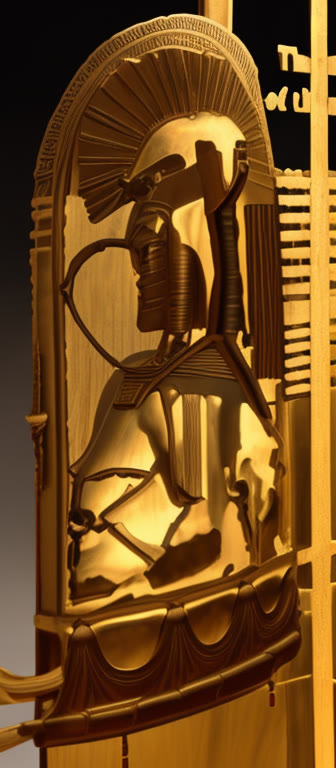
Ceremonial shield: king as sphinx
New Kingdom, 18th Dynasty
Tutankhamun's openwork ceremonial shield with the king as a human-headed sphinx trampling foes (on tour, photographed obliquely in its case).
From the record: Openwork wood shield covered with stucco, gilt and inlaid with ebony: the king as a human-headed sphinx in the double crown trampling southern foes (JE 61577).
Reference photograph: King Tutankhamun's tomb goods The King as Sphinx, ceremonial shield, & Ted DSC 0938 (44744173654).jpg — CC BY-SA 2.0, Bill Abbott; King Tutankhamun's tomb goods: The King as Sphinx, ceremonial shield, & Ted DSC_0938 (Wikimedia Commons)
Sources: 1
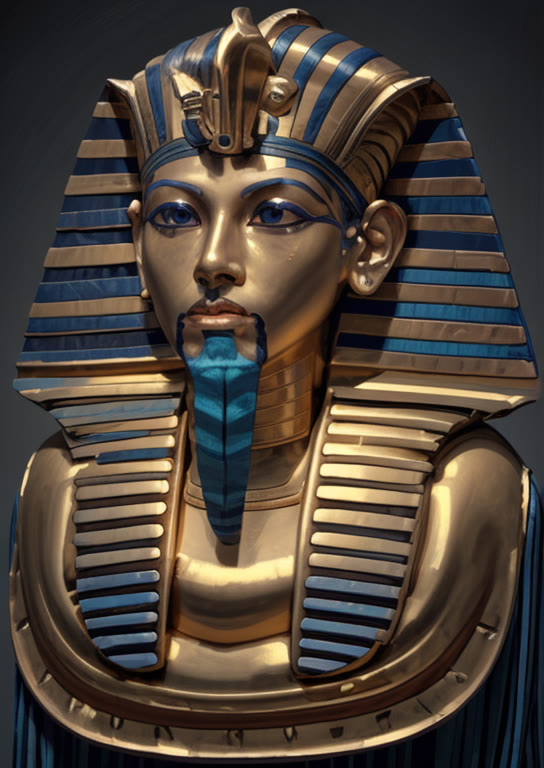
Gold funerary mask of Tutankhamun
New Kingdom, 18th Dynasty
The gold funerary mask of Tutankhamun, front view: blue-glass-striped gold nemes with cobra and vulture at the brow, braided lapis-and-gold false beard, inlaid broad collar.
From the record: Two layers of gold (1.5-3 mm) with lapis lazuli, carnelian, obsidian, quartz, turquoise and glass inlays; 54 x 39.3 x 49 cm, 10.23 kg; nemes with blue glass stripes, cobra and vulture at the brow, broad collar.
Reference photograph: Mask of Tutankhamun in 2025.jpg — CC BY 4.0, Dawid Wdowczyk; Own work (Wikimedia Commons)
Sources: 1
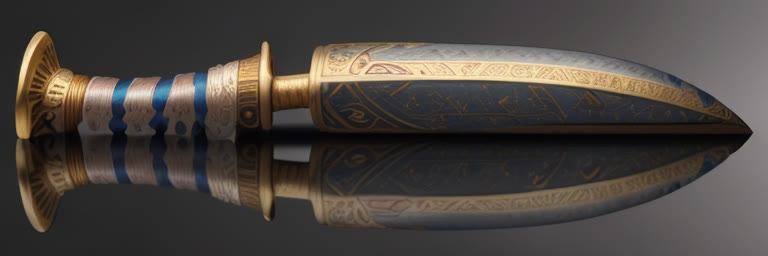
Meteoric iron dagger of Tutankhamun
New Kingdom, 18th Dynasty
Tutankhamun's meteoric iron dagger (Egyptian Museum Cairo), blade and hilt: grey iron blade, gold hilt with granulated and cloisonne bands, rock-crystal pommel.
From the record: Dagger with a meteoritic iron blade (~10.8% nickel), found in 1925 in the king's wrappings; gold handle and rock-crystal pommel, gold sheath.
Reference photograph: Kairo Museum Eisendolch Tutanchamun 01.jpg — CC BY 3.0, Olaf Tausch; Own work (Wikimedia Commons)
Gold uraeus of Senusret II
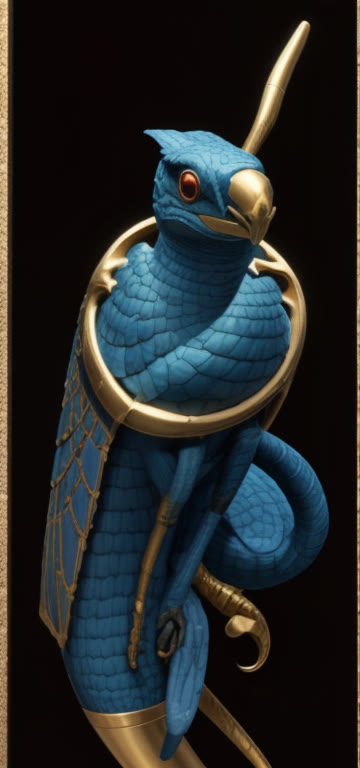
Middle Kingdom, 12th Dynasty
The gold uraeus of Senusret II from el-Lahun (Egyptian Museum Cairo), shown at the 2023 Paris exhibition: rearing cobra with lapis lazuli head, carnelian, turquoise and lapis inlaid hood, gold body looping behind.
From the record: A 6.7 cm gold uraeus found at El-Lahun in 1919, with lapis lazuli head, carnelian and turquoise inlays and granite eyes.
Reference photograph: Uraeus provenant d'une couronne royale de Sesostris II (la Villette, 2023).jpg — Public domain, Tangopaso; Self-photographed (Wikimedia Commons)
Sources: 1
Usekh broad collar
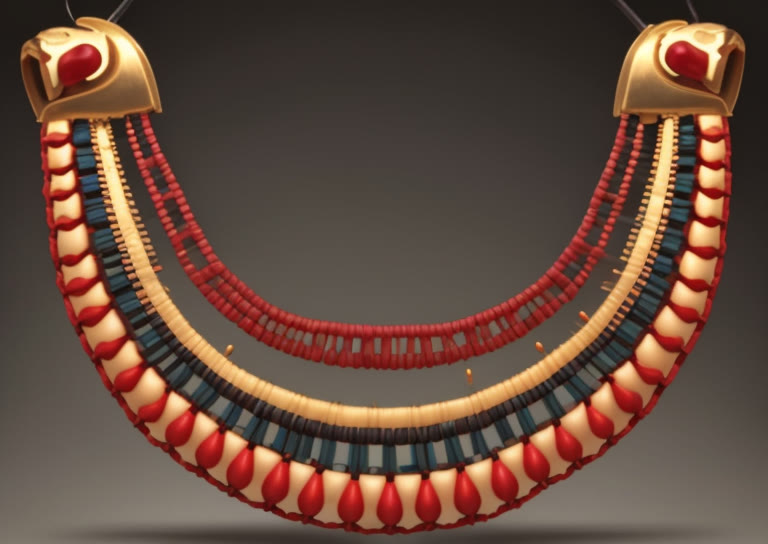
Old Kingdom onward
The broad collar (wesekh) of Senebtisi (Met Museum, Middle Kingdom): curved rows of gold, carnelian, turquoise and black faience tube beads, falcon-head gold terminals, a fringe of gold teardrop pendants.
From the record: Broad collar of tubular and teardrop beads of faience, glass, stone or metal in curved rows with terminals and sometimes a counterweight.
Reference photograph: Broad collar of Senebtisi MET DP303025.jpg — CC0, This file was donated to Wikimedia Commons as part of a project by the Metropolitan Museum of Art. See the Image and Data Resources Open Access Policy (Wikimedia Commons)
Sources: 1
Vulture crown
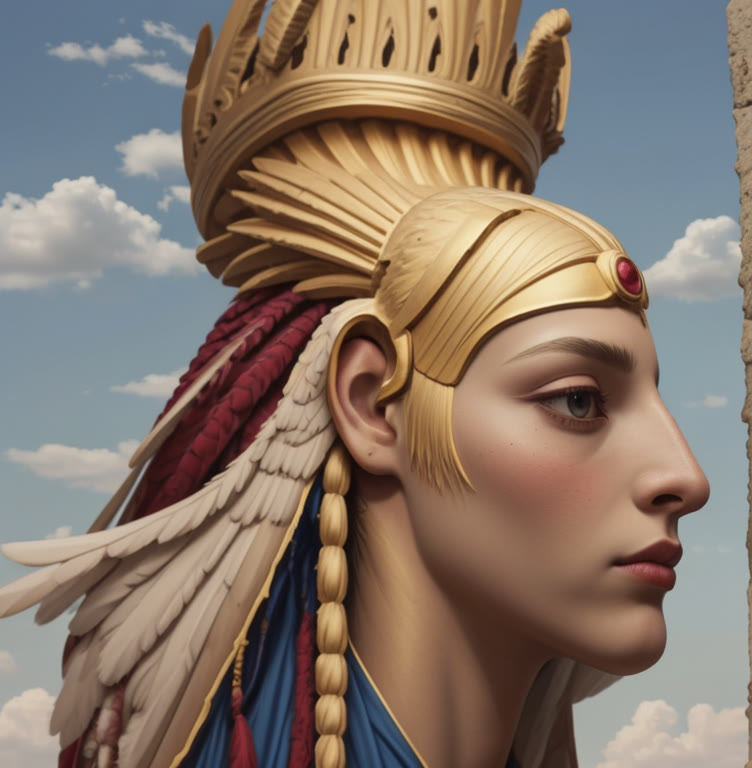
from 5th Dynasty; New Kingdom queens
Limestone sculptor's model relief of a queen or goddess wearing the vulture headdress (Walters Art Museum 22282), profile: vulture head at the brow, feathered vulture body and wing lying over the tripartite wig, low modius of uraei above.
From the record: A vulture draped over the head with wings hanging down the sides, linked to Nekhbet; worn by queens such as Nefertari; in the New Kingdom the vulture head was often replaced by a uraeus.
Reference photograph: Egyptian - Relief - Queen or Goddess with Vulture Headdress - Walters 22282.jpg — Public domain, Anonymous (Egypt)Unknown author; Walters Art Museum: Home page Info about artwork (Wikimedia Commons)
A priestess of Neith at Sais — Egyptian
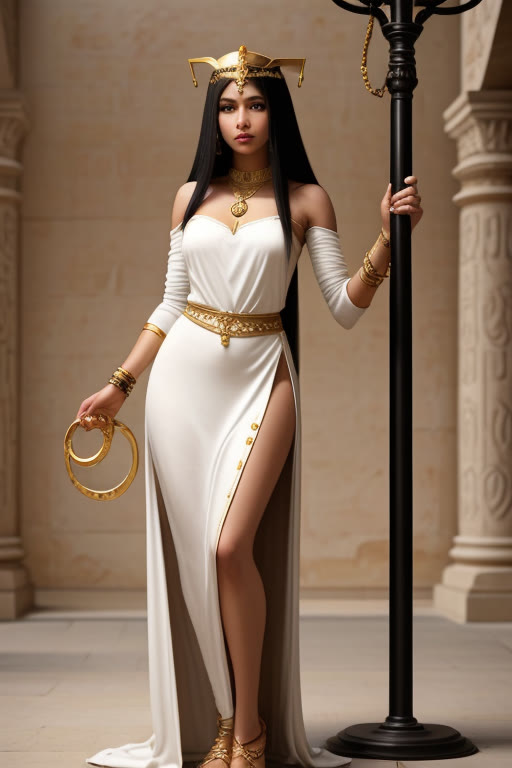
Photorealistic full-body portrait of a priestess of Neith at Sais, a brown-skinned Egyptian woman, c. 600 BCE. She wears an ankle-length white linen sheath dress, a broad collar of faience beads, and a heavy black tripartite wig bound with a red fillet. She holds a bronze sistrum in one hand, and a menat necklace hangs from the other. Behind her, a small gilded emblem of two crossed bows over a shield stands on a pole. There is an upright loom with white linen at one side. Plain sandstone temple sanctuary lit by rows of small oil saucer lamps. Serene, watchful expression.
What the library feeds: the remakes gallery · the animation lab · Hathor Studio.