Hathor’s reference library: the crowns, weapons, armour, chariots, regalia, objects, landscapes and people that the remakes, the animations and the 3D scenes are assembled out of. Every piece was rendered on our own servers from the record kept with it, and where a museum photograph on Wikimedia Commons was the reference, that file, its licence and its photographer are credited under the render.
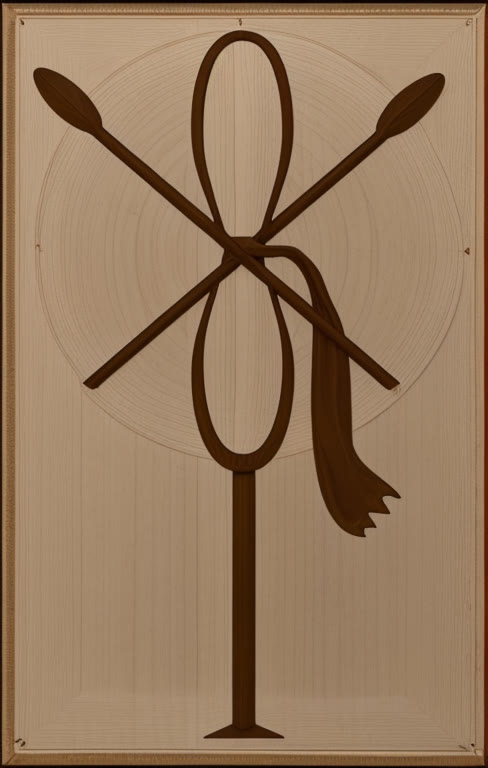
Emblem of Neith: crossed bows over a shield
Early Dynastic; Saite 26th Dynasty
Modern vector drawing of the emblem of Neith as a standard: a figure-of-eight (bilobate) shield with two crossed arrows and a hanging streamer, on a pole — a diagram, not a photo of an artefact.
From the record: Neith's emblem of crossed bows over a shield, also the symbol of her city Sais.
Reference photograph: Neith-Emblem.png — CC BY-SA 3.0 de, Weneg at German Wikipedia; Transferred from de.wikipedia to Commons. (Wikimedia Commons)
New Kingdom war chariot
New Kingdom
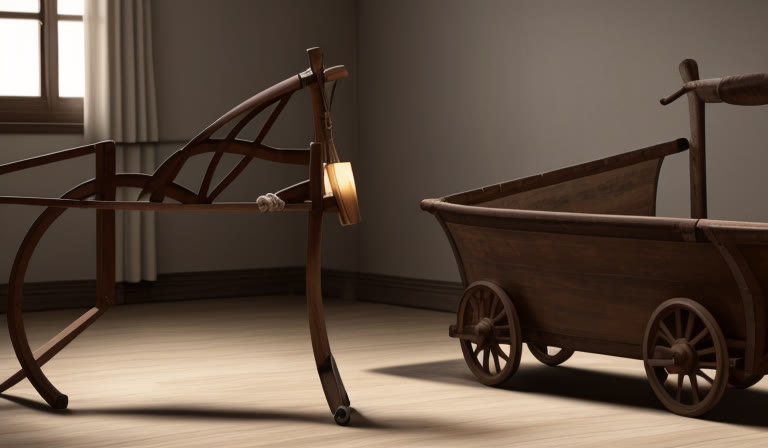
The 18th-Dynasty Egyptian chariot in the Museo Archeologico, Florence (original, from a Theban tomb): light open wooden cab with leather-mesh floor, two four-spoked wheels on a rear axle, long draught pole with yoke, in its display case.
From the record: Cab with two rear-mounted wheels connected by a pole to a yoked pair of horses, crewed by a driver with a shield and a warrior; axle at the back, lighter than Hyksos chariots.
Reference photograph: Egyptian chariot Florence.JPG — CC BY-SA 3.0, Khruner; Own work (Wikimedia Commons)
New Kingdom warship
New Kingdom, 20th Dynasty
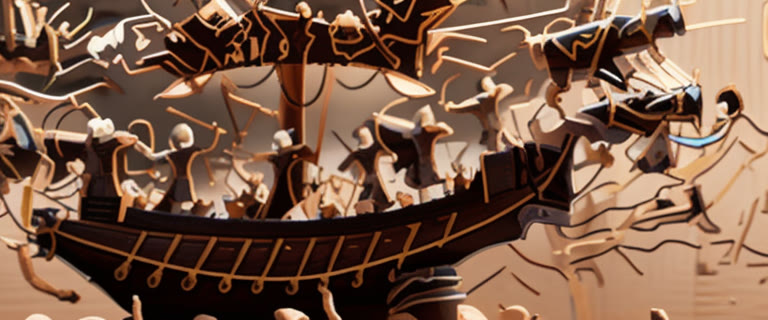
Line drawing (public-domain facsimile) of the Medinet Habu naval-battle relief of Ramesses III: an Egyptian warship with lion-head prow, a row of rowers and oars, single mast with crow's nest, soldiers aboard.
From the record: Ships of the Sea Peoples war: a single mast with horizontal square sail, 70-80 tonnes, about 50 rowers, two steering oars.
Reference photograph: Medinet Habu Ramses III. Tempel Nordostwand Abzeichnung 01.jpg — Public domain, Unknown artistUnknown artist in pay of Ramesses III; Gray, Dorothea (1974) "chapter G" in (in German) Seewesen, Archaeologia Homerica, I, Göttingen, pp. 166−167 (Wikimedia Commons)
Footstool with the Nine Bows
New Kingdom, 18th Dynasty
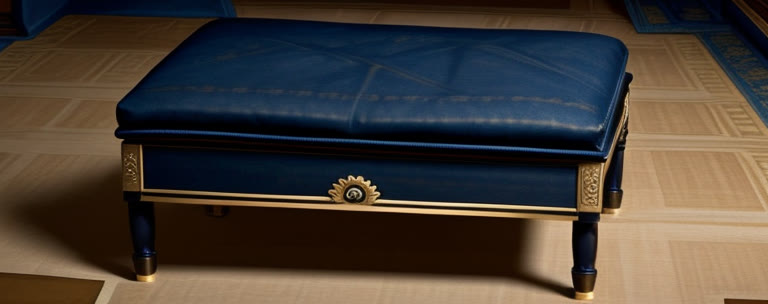
Tutankhamun's footstool displayed in front of the Golden Throne (Egyptian Museum Cairo): gilded and blue-inlaid footstool whose top shows bound foreign captives lying prone, seen through display glass.
From the record: Tutankhamun's footstool is decorated with the Nine Bows, so that each time he stepped on it he trampled his enemies.
Reference photograph: Egyptian Museum 000 (47).jpg — CC BY-SA 4.0, لا روسا; Own work (Wikimedia Commons)
Sources: 1
Sandals with the Nine Bows
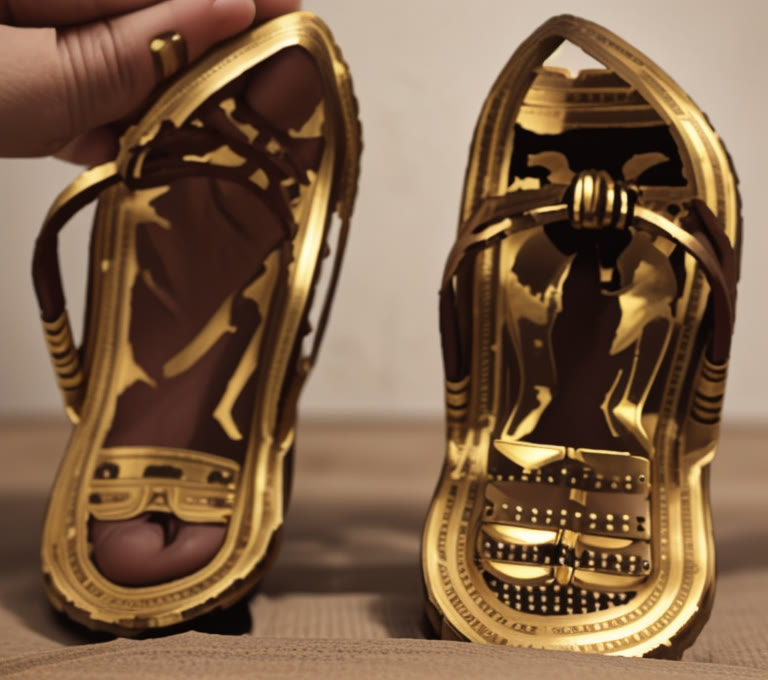
New Kingdom, 18th Dynasty
A pair of Tutankhamun's marquetry sandals (Egyptian Museum Cairo) in their case: bark, leather and gold-foil veneer insoles showing bound Asiatic and Nubian captives and bows, with toe and ankle straps.
From the record: Tutankhamun's sandals carry eight bows in a vertical line and bound foreigners, so the king trampled his enemies as he walked.
Reference photograph: By ovedc - Egyptian Museum (Cairo) - 275.jpg — CC BY-SA 4.0, Ovedc; Own work (Wikimedia Commons)
Sources: 1
Nubian garment with red sash
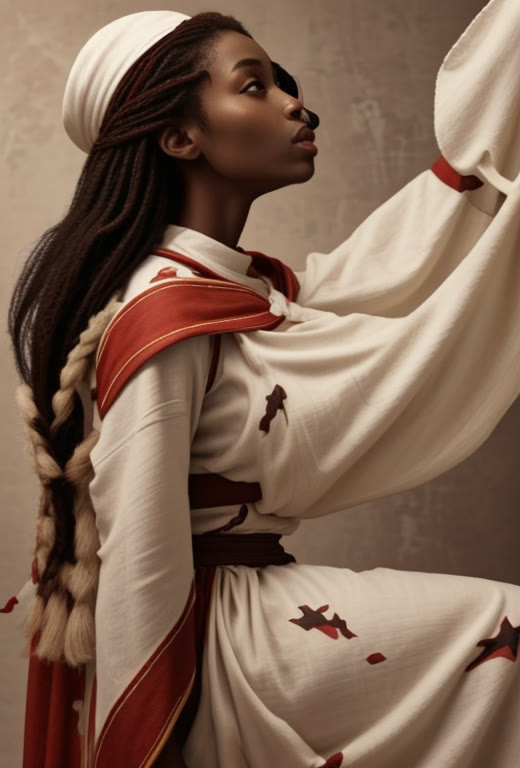
New Kingdom (Book of Gates)
Wall painting from the Theban tomb of Huy (TT40), photographed: the Nubian prince Hekanefer kneeling, wearing a Nubian garment with a long red-and-white sash falling across and down the front, feathers in his hair.
From the record: In the Book of Gates the Nubians wear a thick red sash across the chest; Mesehti's Nubian archers wear a red loincloth.
Reference photograph: Nubian Prince Hekanefer bringing tribute for King Tut, 18th dynasty, Tomb of Huy.jpg — CC BY-SA 4.0, EditorfromMars; Own work (Wikimedia Commons)
Four-plume headdress of Onuris
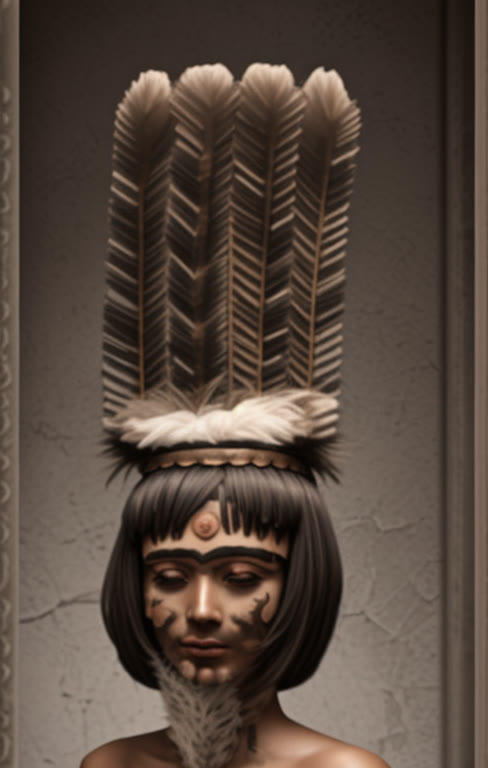
New Kingdom to Roman (divine)
Bronze statuette of the god Onuris (Met Museum, LC-2017.7), head: four tall straight ostrich plumes rising from a low headband over a short wig.
From the record: Headdress of four tall feathers worn by the war god Onuris (Anhur); Tiberius is shown wearing it in temple reliefs.
Reference photograph: Onuris MET LC-2017 7 EGDP025316.jpg — CC0, This file was donated to Wikimedia Commons as part of a project by the Metropolitan Museum of Art. See the Image and Data Resources Open Access Policy (Wikimedia Commons)
Peleset 'feathered' helmet
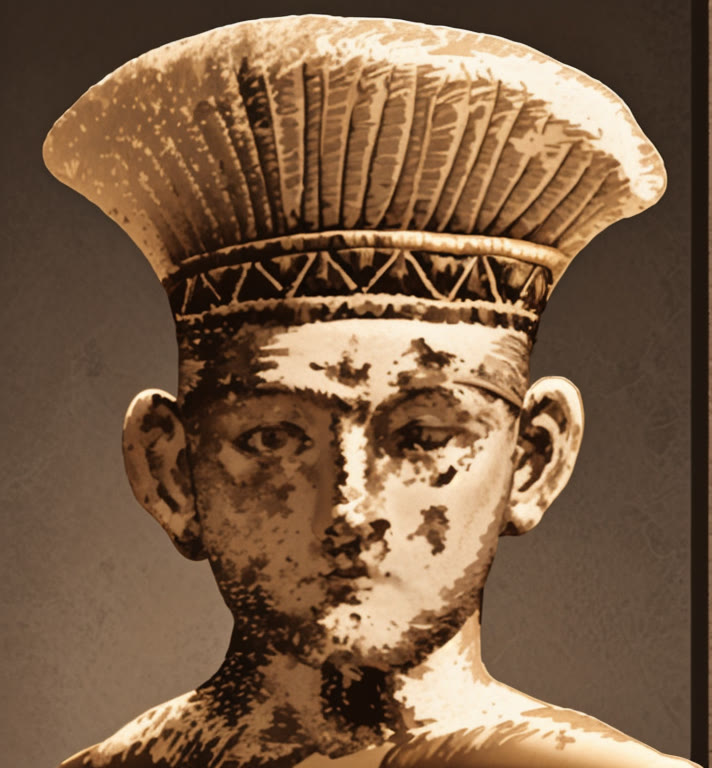
20th Dynasty (Ramesses III)
Engraving (Vigouroux, Dictionnaire de la Bible, after the Medinet Habu reliefs), front view of a Peleset head: tall flaring crown of upright feathers or reeds set in a band decorated with zigzag triangles.
From the record: Peleset are recognisable in Egyptian art by feathered plume helmets, likely made of leather strips; Medinet Habu shows feather-helmeted enemies with ox-carts.
Reference photograph: Types philistins sur le monuments égyptiens de Médinet-Abou-Vigouroux-DB-vol5.jpg — Public domain, Fulcran Vigouroux, ed., Dictionnaire de la Bible, vol. 5 of 5 vols. (Paris: Letouzey et Ané, 1912). (Wikimedia Commons)
What the library feeds: the remakes gallery · the animation lab · Hathor Studio.