Hathor’s reference library: the crowns, weapons, armour, chariots, regalia, objects, landscapes and people that the remakes, the animations and the 3D scenes are assembled out of. Every piece was rendered on our own servers from the record kept with it, and where a museum photograph on Wikimedia Commons was the reference, that file, its licence and its photographer are credited under the render.
Crook and flail of Tutankhamun
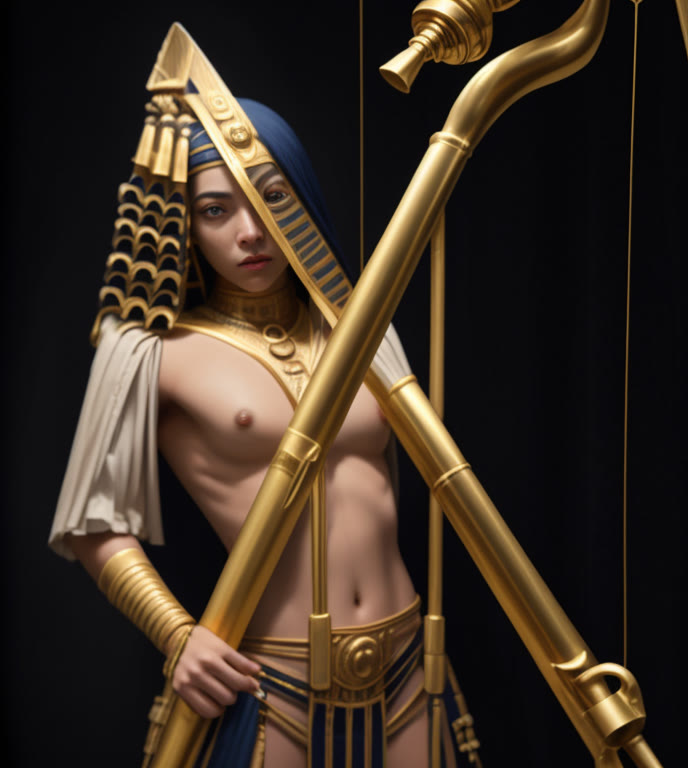
New Kingdom, 18th Dynasty
Tutankhamun's crook (heqa) and flail (nekhakha) crossed on a display stand: gold and blue-glass banded shafts, the flail with three beaded gold pendants.
From the record: The only surviving royal crook and flail: bronze staffs covered in alternating stripes of blue glass, obsidian and gold, the flail beads of gilded wood.
Reference photograph: King Tutankhamun's tomb goods flail and crook DSC 0971 (45709470971).jpg — CC BY-SA 2.0, Bill Abbott; King Tutankhamun's tomb goods: flail and crook DSC_0971 (Wikimedia Commons)
Sources: 1
Deshret (Red Crown of Lower Egypt)
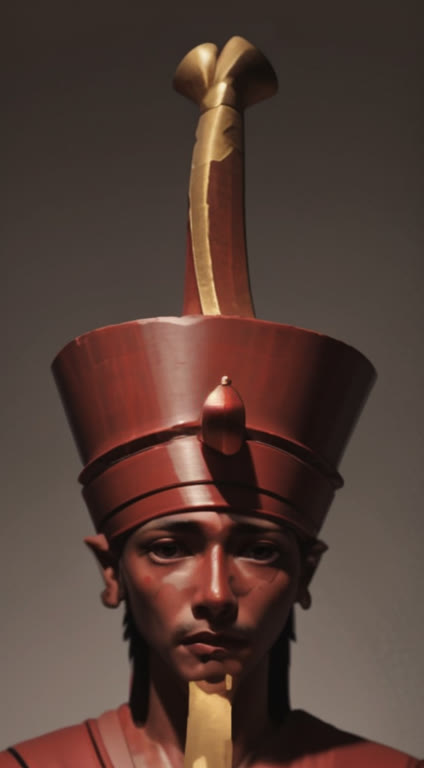
Early Dynastic onward
Bronze statuette of a Kushite king (25th Dynasty, from Saqqara), head and crown: the Deshret red crown of Lower Egypt with its flat cylindrical cap, tall rear projection and the forward-curling wire (khabet), uraeus at brow.
From the record: Red crown of Lower Egypt, worn by pharaohs and by Horus, Wadjet and Neith; dates back to pre-dynastic times.
Reference photograph: Ancient Egypt Bronze Statuette of a Kushite King wearing the Red Crown of Lower Egypt (Deshret), holding 2 wine vessels, from Saqqara, Memphis, Egypt. TIP, 25th Dynasty, c. 670 BC (28672844551).jpg — CC0, Gary Todd from Xinzheng, China; Ancient Egypt Statue with Offering (Wikimedia Commons)
Predynastic disc mace head
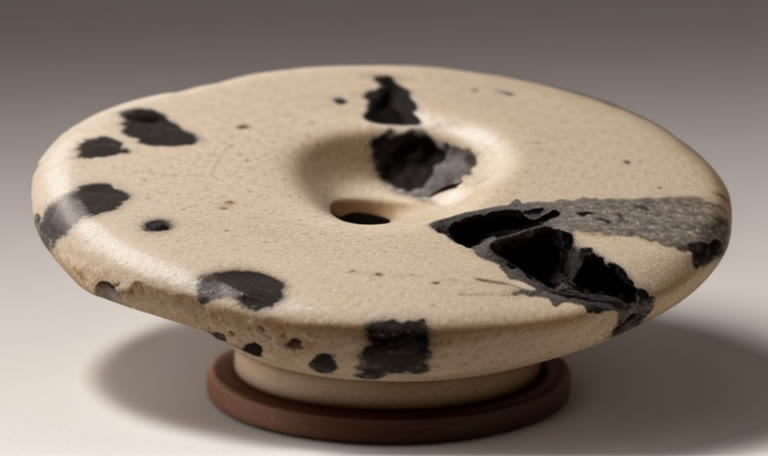
Predynastic, c. 3850-3650 BCE
Predynastic granodiorite disc mace head (Museo Egizio Turin S 569): flat round stone disc with central shaft hole and short collar below.
From the record: Early Egyptian maces with a disc-shaped stone head, short-lived before the piriform type.
Reference photograph: Mace head Granodiorite - Museo Egizio, Turin S 569 p01.jpg — CC0, Museo Egizio (Wikimedia Commons)
Sources: 1
Duckbill axe head
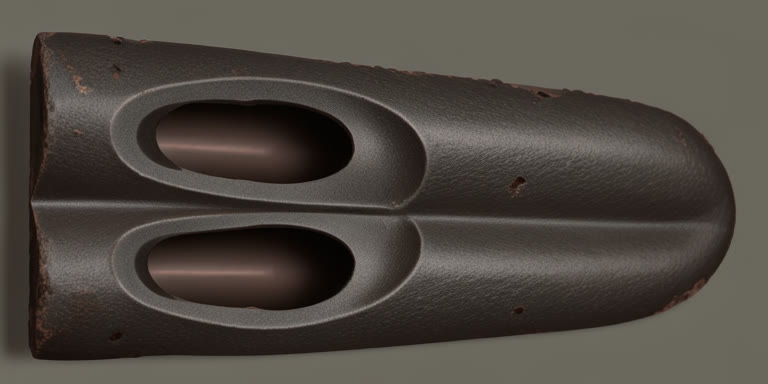
Middle Bronze Age IIA (12th Dynasty); Second Intermediate
Copper-alloy duckbill (fenestrated) axe blade of Syro-Palestinian type, c. 1981-1550 BCE (Met Museum): narrow tapering blade with two oval openings and a socket at the back.
From the record: Syro-Palestinian socketed axe with a narrow blade; one very similar was found in a late 12th-Dynasty tomb at Tell el-Daba (Avaris); carried by the Aamu at Beni Hasan.
Reference photograph: Egyptian duckbill-shaped axe blade of Syro-Palestinian type 1981-1550 BCE.jpg — CC0, Metropolitan Museum of Art; Metropolitan Museum of Art Provided under Public Domain license (Wikimedia Commons)
Egyptian cowhide infantry shield
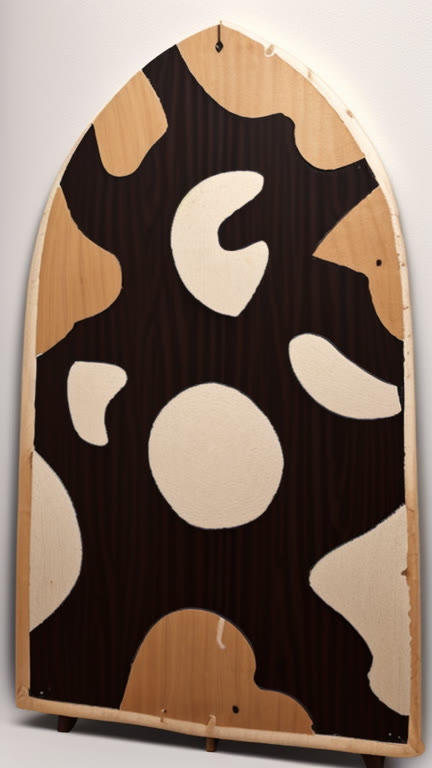
Middle Kingdom - New Kingdom
Painted wooden model shield (Met Museum, Middle Kingdom tomb model): pointed-arch top, black-and-white cowhide pattern, red rawhide edging with stitching.
From the record: Rectangular shield of cowhide or oxhide over a wooden frame, tapering to a curved top, with a handle or leather strip; model shields imitate cowhide with a rawhide edge.
Reference photograph: Model shield MET DP112589.jpg — CC0, This file was donated to Wikimedia Commons as part of a project by the Metropolitan Museum of Art. See the Image and Data Resources Open Access Policy (Wikimedia Commons)
Epsilon axe
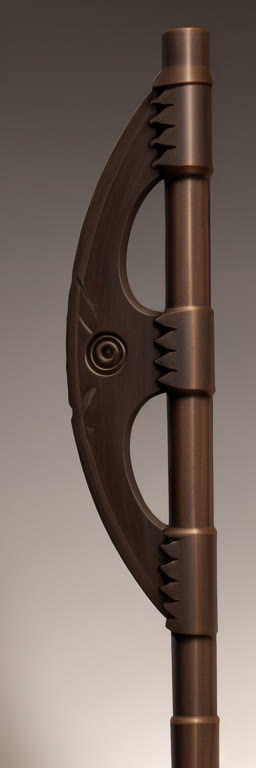
Middle Kingdom - New Kingdom
Egyptian epsilon axe with its wooden haft: crescent-shaped bronze blade with two semicircular openings, its three tangs lashed to the haft with cord bindings.
From the record: Bronze or copper axe head shaped like the letter epsilon, attached to the haft at three points by tangs wedged and lashed into grooves.
Reference photograph: Epsilon axe.jpg — CC BY-SA 3.0, User:RootOfAllLight; https://www.metmuseum.org/art/collection/search/544279 (Wikimedia Commons)
Sources: 1
Golden flies of valour
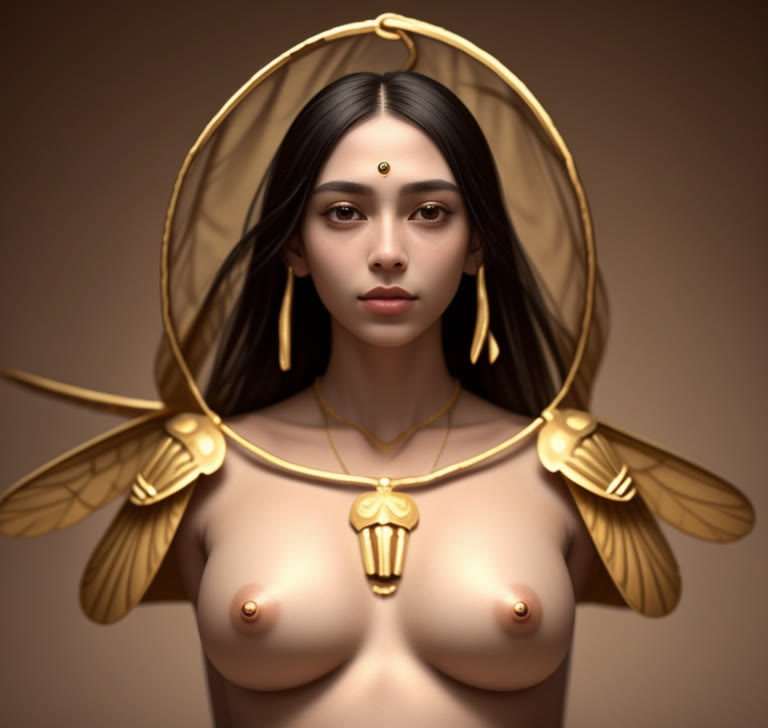
Second Intermediate / early 18th Dynasty
The golden flies of valour from the burial of Queen Ahhotep (Egyptian Museum Cairo): three large stylised gold flies with broad flat wings and openwork bodies, hung on a fine gold chain.
From the record: Three golden flies from the burial of Ahhotep, military awards for distinguished service.
Reference photograph: Golden Flies Military Award Queen Ahhotep Necklace.jpg — CC BY 4.0, Rob Corder; https://www.flickr.com/photos/rocor/55461943105/ (Wikimedia Commons)
Sources: 1
Golden Throne of Tutankhamun
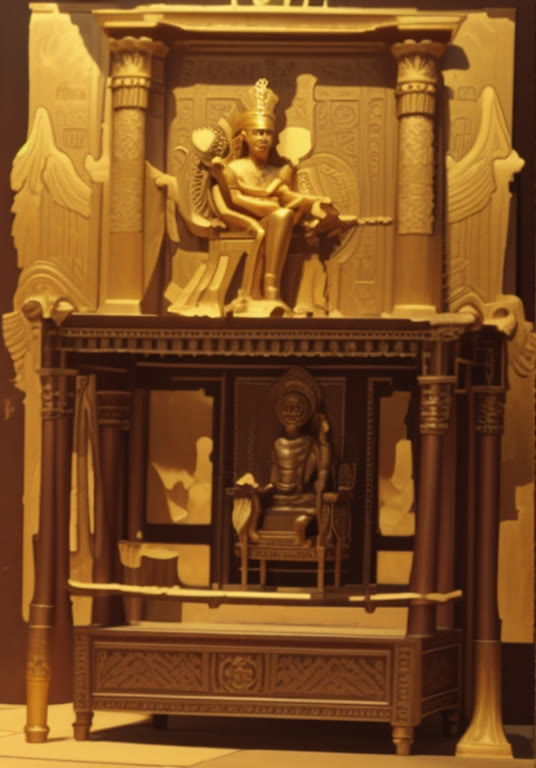
New Kingdom, 18th Dynasty
The Golden Throne of Tutankhamun in its case at the Egyptian Museum Cairo, front view: lion-head front legs, backrest panel with the king and queen under the Aten, winged uraei at the sides (seen through display glass).
From the record: Wood covered with chased gold sheet, inlaid with glass, faience and semi-precious stones; backrest shows the king and queen under the rays of the Aten; winged uraei on the sides; H 103.5 cm.
Reference photograph: Egyptian Museum 000 (47).jpg — CC BY-SA 4.0, لا روسا; Own work (Wikimedia Commons)
Sources: 1
What the library feeds: the remakes gallery · the animation lab · Hathor Studio.