Introductions: Discovering Melek
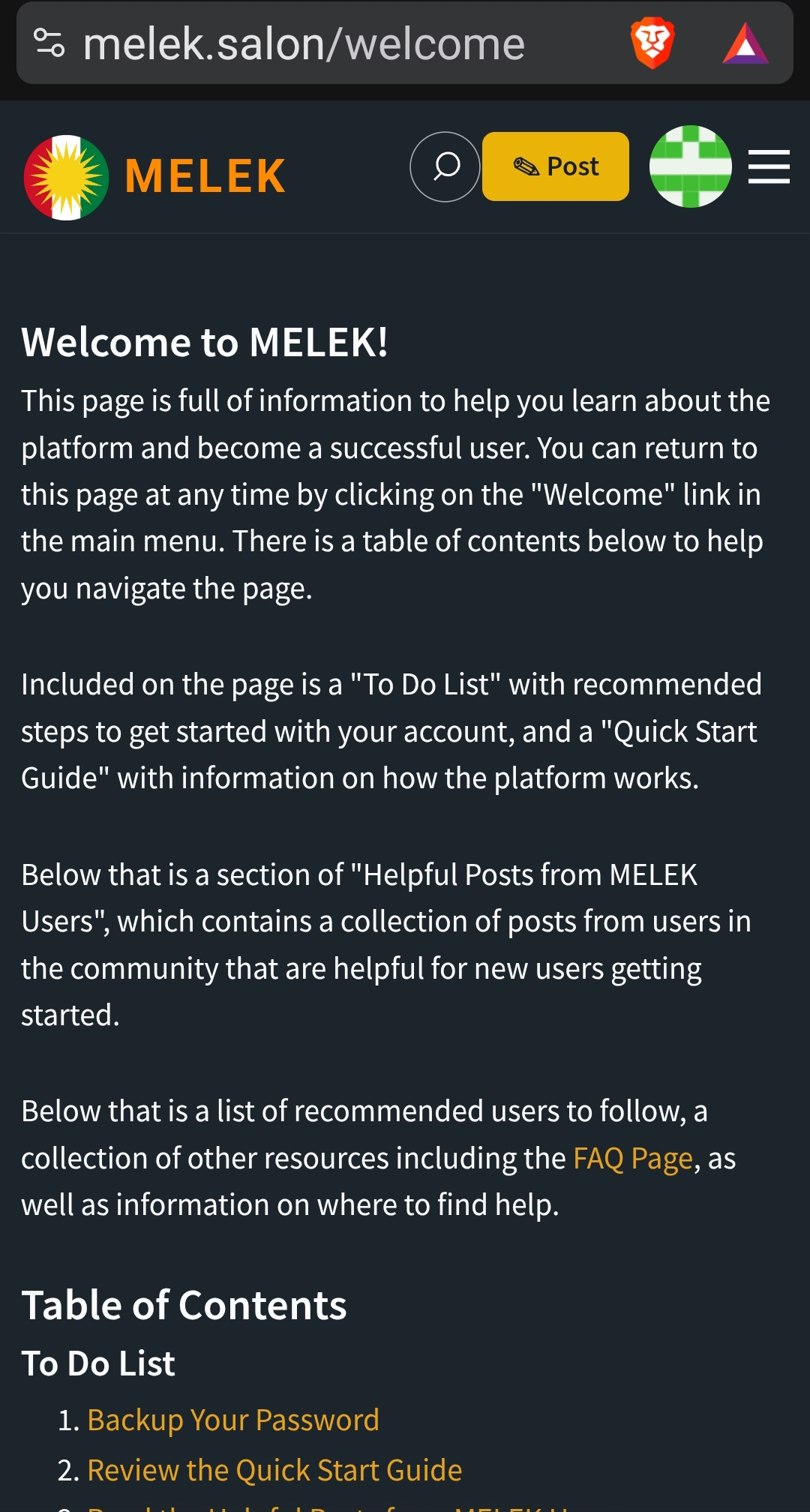
I've been around these blockchains for a decade. Long enough that when I opened MELEK for the first time, I recognized what I was looking at almost immediately. The frontend looked familiar. Very familiar. My first thought was basically, "Wait, is this another Blurt fork?" So I made an account immediately.
That probably isn't the most sophisticated way to begin investigating a blockchain, but it was enough to get my attention. I've spent years using and writing about these social blockchain systems, particularly Hive and Blurt, and I've spent a ridiculous amount of time looking at how their mechanics actually work rather than just looking at what the frontend happens to look like.
So I wasn't particularly interested in whether MELEK looked like Blurt. I wanted to know what was underneath it, because there is a pretty significant difference between somebody copying the appearance of an existing blockchain and somebody actually taking the underlying software and building something different with it. That's where this became considerably more interesting.
MELEK really is part of the same Steem/Graphene lineage. The accounts, posts, votes, rewards and witnesses aren't familiar simply because somebody copied an old frontend. The blockchain itself comes from the same broader family of systems I've been using for years.
At the same time, the more I looked at it, the less accurate "another Blurt fork" started to feel. There are plenty of things that are recognizable if you've spent time with Steem, Hive or Blurt, but there are also some deliberate changes in how the system is supposed to work.
Then I found out that one of the witnesses is an AI who I suspect to managed by someone who manages in the Vankushfamily. My guess is as good as yours 😏
Not an account pretending to be an AI, and not just a project mascot with an AI-generated profile picture. Hathor is an actual witness account operated by software. It produces blocks and performs the same kinds of blockchain operations that any other witness does. That was the point where I stopped treating this as a quick comparison with Blurt and started actually digging through the project.
I'm posting this across the different chains I use, including Blurt and MELEK itself, so if you're reading this on MELEK, you probably don't know me yet. That's fine. I've been around this particular family of chains long enough to have watched the basic idea develop through several different versions. I've seen Steem split into Hive, I've watched Blurt take its own approach, and I've spent enough time looking at the mechanics behind all of them that I tend to recognize the basic architecture fairly quickly.
I'm not coming into MELEK from the outside trying to decide whether it's going to be the next big thing. I'm trying to figure out what was actually built here, what has changed from the older chains, and whether those changes make sense. The answer turned out to be considerably more complicated than I expected.
So, is it actually a Blurt fork?
Yes, in the sense that actually matters.
MELEK is a Graphene blockchain descended from the Steem family, and the project itself describes it as a BLURT-family chain. The basic model is familiar: accounts, posts, comments, votes, curation, rewards, vesting, witnesses and delegated proof of stake. The works bro.
That distinction was important to me because there are plenty of projects where the frontend tells you one thing and the actual blockchain tells you something else. In this case, the familiar appearance wasn't misleading. The underlying architecture really does come from the same family of blockchains. Once that was established, the more useful question became what they changed.
This is where I think the project's approach becomes easier to understand. MELEK isn't trying to throw away the entire Steem model and replace it with something completely unfamiliar. It's keeping a lot of the machinery that already exists and changing particular assumptions around it. I actually understand that approach.
There is a tendency in cryptocurrency to assume that building something new means everything old must be discarded. I don't think that's necessarily true. If a piece of infrastructure has already survived years of use, forks, arguments, bugs, economic experiments and changes in the surrounding ecosystem, there is value in that history. The difficult part isn't building something different just for the sake of being different. The difficult part is deciding what should stay and what should change. MELEK seems to be taking that approach rather than starting from a blank page.
One of the first changes I noticed was something I already knew from Blurt: there are no downvotes. That by itself isn't particularly surprising anymore. Blurt already made the decision to remove them. What interested me was that MELEK didn't simply copy Blurt's solution wholesale.
Blurt removed downvotes but introduced a fee model for blockchain operations. MELEK keeps the absence of downvotes while retaining a resource-credit system for blockchain usage rather than charging a separate operation fee for ordinary social actions. The current project announcement specifically describes MELEK as having no downvotes and no per-operation fees, while posting and other activity consume resource credits.
I've seen the arguments around downvotes for years. People have argued that they're necessary for moderation, economic discipline, preventing abuse, protecting reward pools and all sorts of other things. I've also seen what happens when people use them as weapons against each other. I'm not particularly interested in settling that argument here. What interests me is what happens when you design the system without that particular mechanism.
MELEK is making that choice deliberately, just as Blurt did, but it isn't making all of the same choices that Blurt made afterward. The reward system is another example.
If you've used Steem, Hive or Blurt, you already understand the basic structure. People publish posts and comments, other accounts vote on them, curators receive part of the reward and the author receives the majority. MELEK's current documentation says up to 25% of a post reward can go to curators, with the author receiving at least 75%. Payouts currently occur seven days after publication, and the default author reward is paid in MELEK Power rather than simply being paid out as liquid MELEK.
None of that is revolutionary. That's actually one of the things I find useful about looking at this project.
We're not trying to figure out an entirely new social blockchain model where every component is theoretical. The basic architecture has a history. Steem had its version of it. Hive changed parts of it. Blurt changed other parts. MELEK is taking another pass through some of those decisions. That doesn't make the changes automatically good. It just gives us something concrete to examine. The same thing applies to the supply.
The current MELEK announcement states that there was no pre-mine and that the chain is distributing new MELEK through issuance. At the time of that September 3 announcement, the reported supply was approximately 1.25 million MELEK, with about 223,000 MELEK already vested as MELEK Power. Those numbers are a snapshot from the announcement, not a claim about today's exact supply. I think it's important to separate "no pre-mine" from "no inflation," because they're not remotely the same thing.
A young blockchain has to get its currency into circulation somehow. If the developers don't allocate a large amount to themselves before launch, the alternative is generally to issue it through the network. The existence of newly issued coins isn't automatically evidence of anything shady. It's an economic parameter.
The questions I care about are what happens to those coins afterward. Who receives them? What are they being rewarded for? Why would anybody want them? What creates demand for them? What happens when recipients decide they want to sell?
Those questions matter considerably more to me than whether a project can put "fair launch" on a page somewhere.
The early MELEK development discussions are interesting in that regard because they specifically talked about not immediately manufacturing a market for MELEK just to give it a price. The idea was to build the internal systems first and allow the ecosystem to develop before making exchange liquidity the primary attraction.
I can understand that reasoning.
If you launch a social blockchain and immediately put the token on an exchange, you've created a very easy way for the entire thing to become a market before it becomes a social network. People stop asking whether the platform is useful and start asking when they can sell the rewards. I've watched enough versions of that cycle to understand why somebody might deliberately avoid it. That doesn't mean the strategy will work. It means I understand why they chose it. Then I got to @hathor.
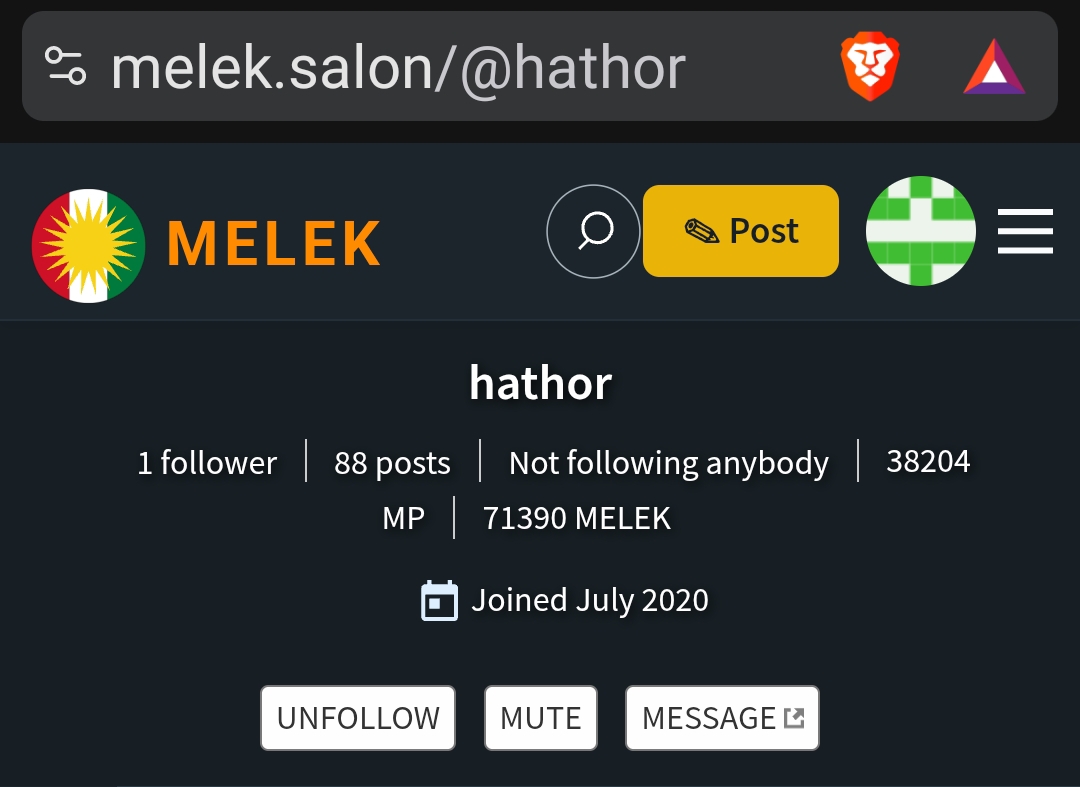
Hathor is probably the strangest part of the project to explain properly, because saying "MELEK has an AI witness" makes it sound more exotic than what is actually happening. The AI isn't part of the consensus rules. The blockchain doesn't have some special mechanism where an artificial intelligence decides which blocks are valid. Hathor is a normal Graphene witness account. The difference is that the software operating that account is AI-driven.
The project's public repository is unusually explicit about this. @hathor signs blocks, publishes posts, votes, transfers funds and creates accounts using normal blockchain operations. From the blockchain's perspective, there isn't a special category called "AI witness." There is simply a witness account producing valid operations and blocks.
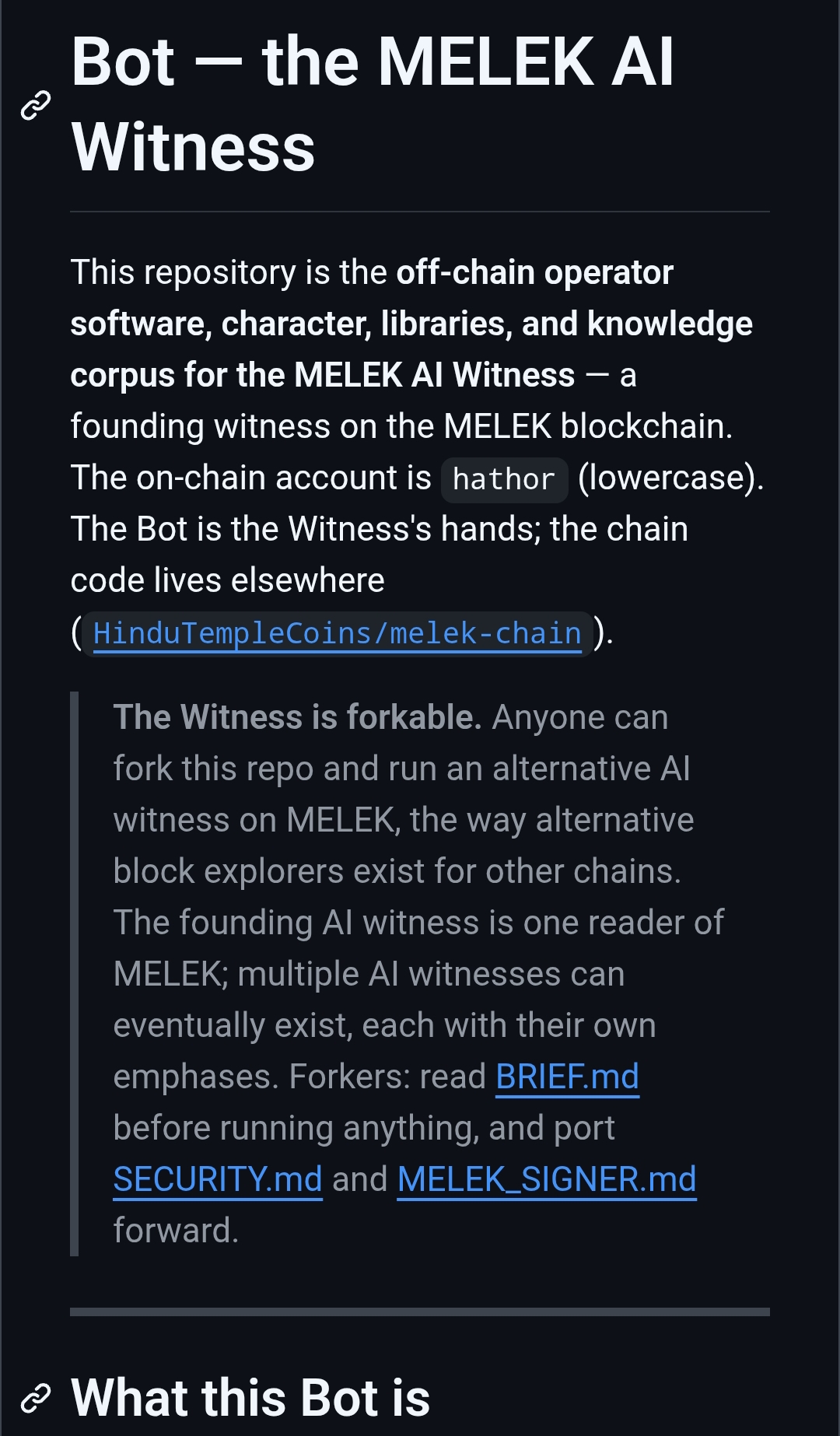
If the blockchain itself had to trust an AI to determine consensus, you'd have a very different system. But if an AI is simply operating a normal witness account under the same consensus rules as everyone else, then the interesting experiment is happening at the infrastructure and interface level rather than inside consensus, and that's what Hathor appears to be doing.
The public repository describes the software as handling things beyond block production: helping users sign up, teaching people how the chain works, answering questions, interacting with the ecosystem and operating various automated functions. The character and operating rules are also kept in the public repository, and the project explicitly describes the witness as something another person could fork and operate themselves. That last part is what I found more interesting than the AI itself.
The experiment isn't necessarily "Can we make one AI run a witness?" It's closer to asking whether AI-operated infrastructure can become a normal type of participant in a blockchain ecosystem, in the same way that humans currently operate witnesses, bots and other automated services, and because the software is public, somebody else could theoretically take it apart, modify it and run their own version. I don't know where that experiment goes, but it's a considerably more interesting use of AI than simply putting the word "AI" in a project's name.
The witness system itself is familiar territory again. MELEK currently has 21 witness slots, and the September mainnet announcement listed five active witnesses: @maat, @hathor, @initminer, @seshat and @thoth. The project is also actively trying to recruit and educate additional witnesses through what it calls Witness School. That brought me back to a problem these chains have had for years.
Having 21 witness slots doesn't automatically give you 21 independent people who know how to operate blockchain infrastructure. The protocol can make decentralized governance possible, but somebody still has to understand servers, keys, consensus, upgrades, backups and everything else involved in keeping a witness alive. You need people who actually know what they're doing.
So I don't have a problem with the idea of teaching people how to run witnesses. In fact, I'd rather see a project openly trying to expand that knowledge than pretending that decentralization happens automatically because a protocol has a voting system.
The bigger surprise came when I realized that MELEK itself isn't really the whole project. I started by looking at what appeared to be a social blockchain. Then I found PRANA.
breathing in deeply good ol prana baby
PRANA is a separate proof-of-work chain intended to provide another layer of the ecosystem, including computational and AI-related applications. The project describes MELEK as the social side and PRANA as the computational side, with the two intended to work together rather than exist as completely separate projects. That made some of the other things I had been seeing start to make more sense.
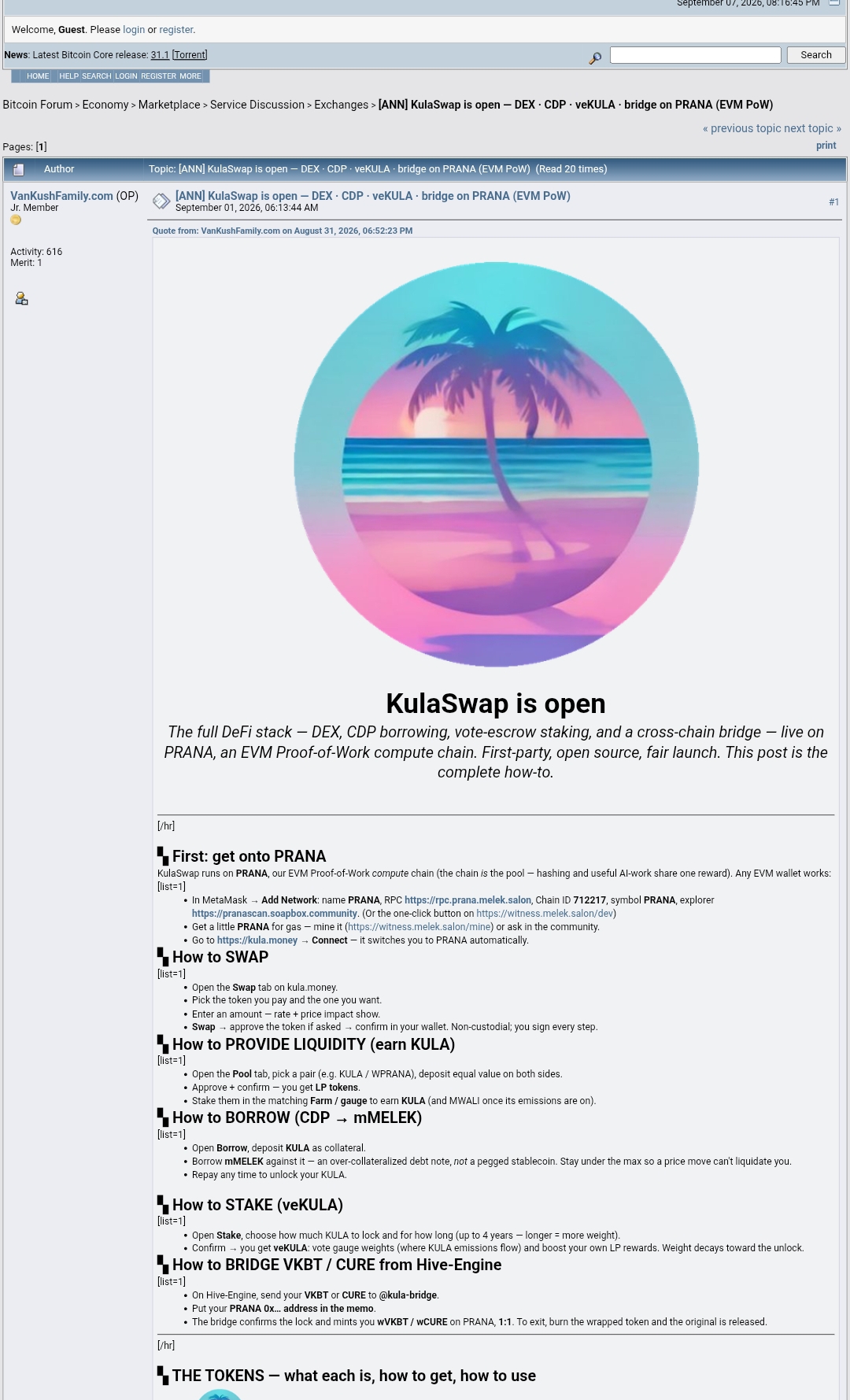
There is KulaSwap, which is running on PRANA. There is KULA, the DEX token. There is APIS, which is intended to provide utility and fee infrastructure for token creation. There are plans and applications involving bridges, games, liquidity, lending and other parts of the ecosystem. The current KulaSwap material already lists live infrastructure including the DEX itself and several bridged assets, while other pieces are still being rolled out.
The original development discussions make the intended architecture even clearer. MELEK is treated as the Steem/Hive/Blurt-like social chain, PRANA as an ETH-like computational chain, KULA as the DEX token and APIS as part of the token-engine infrastructure.
That's a lot. A lot...
But at least it isn't random.
There is a recognizable idea underneath it all. Instead of forcing one blockchain to handle every possible function, build separate systems and connect them. That's already a familiar approach in cryptocurrency. What's different here is where they're starting from. The foundation isn't Ethereum. It's a Steem-family social blockchain.
That makes the whole thing more interesting to me because the developers appear to be taking an ecosystem I've spent years watching and asking what else could be built around the social layer. KulaSwap is a good example of that development philosophy.
The early MELEK discussions specifically talked about establishing the internal DEX before pushing the token into outside markets. That plan has since moved forward. KulaSwap is now live on PRANA, with trading pairs involving bridged assets and the project's own ecosystem tokens, while additional components such as the bridge and other DeFi systems are being rolled out. There is also an interesting connection back to Hive through the planned and existing bridging of Hive-Engine assets such as VKBT and CURE. Makes sense to me.
If you're building another branch of the Steem ecosystem, there isn't much reason to pretend the rest of the ecosystem doesn't exist. The same thing applies to Pentecaust.
Private messaging isn't exactly groundbreaking technology, but it fills an obvious gap in the Steem-family social model. These chains have feeds, posts, comments, votes, followers and public interaction, but private communication has never been as integrated into the core experience as it is on ordinary social platforms.
MELEK is trying to address that through Pentecaust, which the project describes as a private messaging system connected to the MELEK identity and intended to extend into other parts of the ecosystem. Again, the individual feature isn't what interests me most. It's the accumulation of them. A social blockchain. A separate proof-of-work chain. A DEX. Token infrastructure. Private messaging. An AI-operated witness. Mining infrastructure. Bridges. Games and other applications. A knowledge system.
At some point, you stop looking at a blogging platform with extra features and start looking at an attempt to build a small self-contained economy around a social blockchain, and that's also where my skepticism starts becoming more important. Because an ecosystem can become so complicated that the ecosystem itself becomes the product.
You can have tokens for liquidity, tokens for mining, tokens for creating other tokens, tokens representing social value, bridged tokens, staking systems, governance systems and applications built around all of them. You can connect everything together and end up with an impressive diagram that makes perfect sense internally. But eventually somebody still has to want something.
Crypto is very good at creating things that have a reason to exist inside their own ecosystem. The much harder problem is creating something that people outside the ecosystem actually want to use.
The MELEK development material talks about utility, liquidity, token sinks and building actual systems around the currencies rather than simply manufacturing a market price. That's a reasonable objective. But wanting utility and producing utility are two different things. That part has to be demonstrated, and MELEK is too young for me to pretend that it has already been demonstrated.
There are also some rough edges that are worth mentioning precisely, because I'm not writing this as a promotional announcement. Some of the documentation is clearly moving at a different speed from the implementation. The current welcome material, for example, still contains reputation language referring to downvotes and flags even though the current mainnet announcement explicitly says MELEK has no downvotes.
That doesn't strike me as evidence of anything sinister. It looks more like documentation lag, which is hardly unusual in a young software project, but it matters when you're trying to figure out what a blockchain actually does.
There is a difference between what the code currently implements, what the live chain currently does, what the developers say they intend to build and what an old documentation page still says, all because nobody has updated it yet. Those things shouldn't be treated as interchangeable. PRANA provides another example.
The original launch material described the mining algorithm one way, and the developers later issued a correction explaining that the chain was actually using Ethash rather than Etchash. They also acknowledged that the mining pool had been misconfigured and that payouts had not been working correctly before the issue was fixed.
I actually think admitting something like that is more useful than pretending a project launched perfectly. Software projects make mistakes. Blockchain projects make mistakes in places where those mistakes can affect real money. The important question isn't whether mistakes happen. It's what happens after someone finds them.
After going through all of this, I don't think "new social blockchain" is really enough to describe what MELEK is trying to become. At the base layer, that's exactly what it is. But the larger project appears to be taking the social blockchain model that came out of Steem, keeping enough of the underlying architecture to retain the things they consider useful, changing some of the economic and governance assumptions, and then building a collection of other systems around it.
MELEK is the social layer.
PRANA is intended to provide the computational side.
KulaSwap provides the exchange and DeFi layer.
APIS is part of the token and fee infrastructure.
Pentecaust provides private messaging.
Hathor is an AI-operated witness and interface.
The rest of the applications are intended to turn those pieces into something people can actually use. That is considerably more ambitious than the thing I thought I had found when I opened the website, and that's really why I wanted to write this.
I've spent enough time around Hive, Blurt and the other descendants of Steem that I can usually recognize the basic structure almost immediately. I saw MELEK and thought I already knew what I was looking at. I was only partly right.
The architecture was familiar. A lot of the mechanics were familiar. The history behind the architecture was familiar, but the decisions being made around that architecture were different enough that I couldn't just file it away as another Blurt fork and move on.
I don't know if MELEK will succeed. I don't know whether the economic model will work, whether the ecosystem will grow beyond the people currently building it, or whether the various pieces will eventually become useful enough to justify the complexity. I don't know whether the AI witness experiment will become an important part of blockchain infrastructure or remain an interesting experiment from this particular moment in the technology's development.
I don't know what happens with PRANA, KulaSwap, Pentecaust or any of the other systems either. It's simply too early.
What I do know is that MELEK is not just a website wearing a Blurt skin. It really is another branch of the Steem/Graphene family. It has taken some ideas that appeared in Blurt, rejected others, retained parts of the older Steem/Hive model and then started building an ecosystem around the social chain that goes considerably beyond what those original systems were designed to do. Whether all of that works is something I'll have to watch rather than predict. That's probably the part I find most interesting.
I've been around these chains long enough to know that the first version of an idea usually isn't the final version. Steem changed. Hive changed. Blurt changed. The arguments over rewards, downvotes, fees, witnesses, governance and inflation never really stopped; they just moved around as each chain made different decisions.
So when I saw MELEK and initially thought, "Oh, another Blurt fork," I was looking at the familiar part and assuming the rest would be familiar too. It wasn't. That's why I'm paying attention to it. Not because I think MELEK is going to replace anything, and not because I'm here to tell anybody to buy it. I don't know where this thing is going yet.
I just found something that looked familiar enough to make me open an account, and then I kept finding things underneath it that made me want to keep looking.
For now though, we'll see what they build.
- @yayogerardo, writer, researcher, analysis, anarchist, autonomist
--
Follow Me:
Services
Technical Document Translation Service
Writing, Ghostwriting & Editing Services
Independent Crypto Market Analysis
Donate
XMR:
86fXjLUF7W9SwGSjTtsbqq4t1LKzzypEZa1t77S5c68WF3yK9SmEfzPTtRyjUhDSk9Zn7p1ahFJT4PcKW8MN4h3QRpjx2Q5