The Sixth Month's Fire: Reclaiming Vulcanalia, the August Holiday America Never Got
A #VanKushFamily / Melek.Salon awareness post
August doesn't feel like it belongs to anyone. No fireworks, no trees, no candles — just heat. But it wasn't always a placeholder. Before it was August, it was Sextilis — simply "the sixth month" — back when the Roman year opened in March and ran only ten months long. It only became "August" in 8 BCE, when the Senate voted to rename it after Augustus Caesar, citing his first consulship, his triple triumph, and the fall of Egypt, all of which had landed in that month. July got the same treatment a few years earlier, renamed for Julius Caesar. Everything after August — September, October, November, December — still carries its old number in its name (seven, eight, nine, ten), a fossil left over from the days before January and February existed at all.
That fossil record is the whole point of this post. Calendars are not neutral. They are edited, over and over, by whoever holds the pen — and so are the gods who get holidays inside them.
Our Calendar, and How Rome Kept Score
Rev. George Nichols Packer's 1893 book Our Calendar: The Julian Calendar and Its Errors lays out just how deliberately the Romans engineered their year. The month names Packer walks through are numbers wearing togas — Quintilis (fifth) became July, Sextilis (sixth) became August, while September, October, November, and December kept their raw numbers (seven, eight, nine, ten) even after Numa Pompilius tacked January and February onto the front of the year around 700 BCE. Packer also covers the mechanics the Romans used to mark time inside each month: the Kalends (the first day, when the pontiffs literally called the people together to announce that month's sacred days), the Nones, and the Ides. The Kalends wasn't just a date — it was an act of authority. Someone had to stand up and declare what the month would hold.
That's the piece worth sitting with: the Roman calendar was never a passive record of the sky. It was a running act of institutional decision-making — popes, senates, and emperors continually re-declaring what days meant, right down to Gregory XIII suppressing ten days outright in 1582 to fix the drift Packer spends half his book explaining.
The Oracle Template: How Rome Installed a Goddess
If a senate can rename a month for a man, it can also install a god. Rome did exactly that in 204 BCE, during the darkest years of the war with Hannibal. The Senate opened the Sibylline Books — Rome's guarded library of oracular verse, purchased centuries earlier and consulted only in crisis — and the oracle inside told them plainly: bring the Idaean Mother to Rome, and the invader would be driven from Italy. An embassy sailed to Pessinus in Phrygia and returned with a black meteoric stone believed to be the goddess Cybele. The Senate ruled that Rome's "best man" (vir optimus) had to be the one to receive her — they chose Publius Cornelius Scipio Nasica, who met the ship at Ostia and passed the stone into a relay of Rome's most honored matrons, who carried her in procession up to the Palatine. Within a few years Hannibal was gone from Italy and Scipio Africanus had broken Carthage at Zama. Cybele had her temple by 191 BCE, dedicated as Magna Mater, "Great Mother" — a foreign goddess formally adopted into the Roman state religion on the direct instruction of an oracle.
This is the pattern worth naming out loud: a holiday, a cult, even a god's citizenship in a pantheon, can be the result of a deliberate, documented, political act of installation — not something that only ever grows organically out of folk practice. Rome did it in the open, with a paper trail.
It happened again and again after Rome went Christian, just with different paperwork. Sol Invictus's December 25th birthday feast became the day the Nativity is kept. St. Brigid inherited the hearth-and-forge devotion once paid to the goddess Brigantia in Ireland. All Saints' Day was set on November 1st, sitting almost exactly on top of the Gaelic Samhain. Isis nursing Horus gave Christian iconography a visual template it never fully let go of. Historians argue about how deliberate each of these particular swaps was — some look like genuine calendar overlap, others like conscious pastoral strategy — but the overall mechanism is not in dispute: saints, popes, and councils have repeatedly stepped into the calendar slots gods used to occupy. The instruction manual is the same one the Senate used with Cybele: when a date already has gravity, don't fight it — reoccupy it.
Vulcan's Day, and the Fire Rome Never Fully Explained
Which brings us to August 23rd — Vulcanalia — the one Roman fire-god feast that has genuinely never been ported into the American calendar in any form.
Vulcanalia was old even by Roman standards. Tradition credited the Sabine king Titus Tatius, centuries before the Republic, with founding Vulcan's cult in Rome. The festival landed deliberately in the hottest, driest stretch of the Roman summer — the exact window when granaries, dry fields, and closely packed wooden housing were most likely to go up in flames. The core ritual was a kind of reverse sacrifice: heads of household threw live fish, or small animals, into open bonfires — offering up something living in place of the city, its grain stores, and its people. Households hung cloth and fabric out under the direct sun that day as well, a detail worth sitting with if you've spent any time with wax-and-linen ritual technology from Egypt — sun, heat, and fabric doing something together on purpose, not by accident.
Then real fire answered. The Great Fire of Rome broke out on July 19th, 64 CE, and burned for roughly nine days, gutting most of the city — arriving in the same fire-hazard season Vulcanalia existed to appease, even if not on the festival day itself. Nero funded relief out of his own funds, and ancient writers still argued for centuries over whether he'd let the city burn on purpose. Fifteen years later, on August 24th, 79 CE — the day directly after that year's Vulcanalia — Vesuvius buried Pompeii and Herculaneum. The god of destructive fire had, by Roman reckoning, gone unappeased two years running. Emperor Domitian responded exactly the way Rome always responded to angry gods: he built a new altar to Vulcan on the Quirinal Hill and added a red bull-calf and red boar to the sacrifices. Vulcanalia is still marked in pockets of modern Italy — Naples keeps a living folk memory of the date — but there is no equivalent observance anywhere on the American calendar. A month named for an emperor's victories, sitting on top of a far older fire-god's feast day, and neither one gets so much as a nod here.
Vulcan, Hephaestus, and the Watcher Who Taught the Forge
Vulcan's Greek face is Hephaestus — smith of the gods, maker of Achilles' armor, keeper of a forge under the mountain. That's uncontroversial mythology. The connection worth drawing out for a Melek.Salon reader is the older, stranger parallel sitting in the Book of Enoch: the Watcher Azazel, "teaching all unrighteousness on earth," is credited specifically with instructing humanity in metalwork —
"And Azazel taught men to make swords, and knives, and shields, and breastplates, and made known to them the metals of the earth and the art of working them..." (1 Enoch 8:1)
Read that list slowly. Swords and knives are the edge — offense, and by extension deterrence: the old "peace through strength" logic, where the blade exists so it doesn't have to be used. Shields and breastplates are the opposite pole — defense, protection, the body made survivable. A forge-god, in both the Greek and the Enochic tradition, hands humanity the same two-sided gift: the capacity to wound, and the capacity to be shielded from wounding, in the same delivery.
The breastplate is where this gets its sharpest turn, because Israel had its own sacred one — the choshen, the High Priest's breastplate of judgment described in Exodus 28, set with twelve stones, one engraved per tribe, worn over the heart with the Urim and Thummim tucked behind it for seeking divine judgment. Twelve stones for twelve tribes is its own kind of map — not identical to the Table of Nations in Genesis 10, and not identical to a zodiac wheel, but sitting in the same conceptual family as both: a body of stones standing in for a body of peoples, worn as armor over the chest of the one man allowed closest to the presence of God. A blacksmith-god's breastplate protects a body. A priest's breastplate maps a covenant onto the same anatomical spot. Different registers, same organ, same instinct to put the sacred structure of a people directly over the heart.
Ogdoads, Enneads, Aeons, and Abraxas
Egypt itself ran multiple, competing accounting systems for how many gods sat closest to the beginning of everything. Hermopolis kept an Ogdoad — eight primordial deities, paired male and female, representing formless qualities like darkness, hiddenness, and infinity, out of which the first sunrise broke. Heliopolis countered with an Ennead — nine gods descending from Atum, running down through Shu, Tefnut, Geb, Nut, Osiris, Isis, Set, and Nephthys. Neither cancelled the other; Egypt was comfortable holding both counts at once, the same way it held Vulcan's Roman fire and Hephaestus's Greek forge as two names circling one function.
Centuries later, Gnostic teachers reached for the same architecture to describe the space between an unreachable God and the material world. Aeons — emanated beings, paired again, filling out something they called the Pleroma, the "fullness" — did the structural job the Ogdoad and Ennead once did, stacking layers between the formless source and the visible world. Abraxas, the name Basilides attached to a ruling principle over 365 heavens (its Greek letters sum to 365 by gematria), is the same impulse taken further still: a name built to be a calendar, one ruling day-power folded into a single word. Whether you read Abraxas as a real spiritual claim or as a very old piece of numerological engineering, the throughline from Hermopolis to Alexandria is consistent — sacred systems keep re-deriving the same move, layering countable divine ranks between the ordinary day and whatever they believe sits behind it.
The Wax, the Sun, and the Feast in August
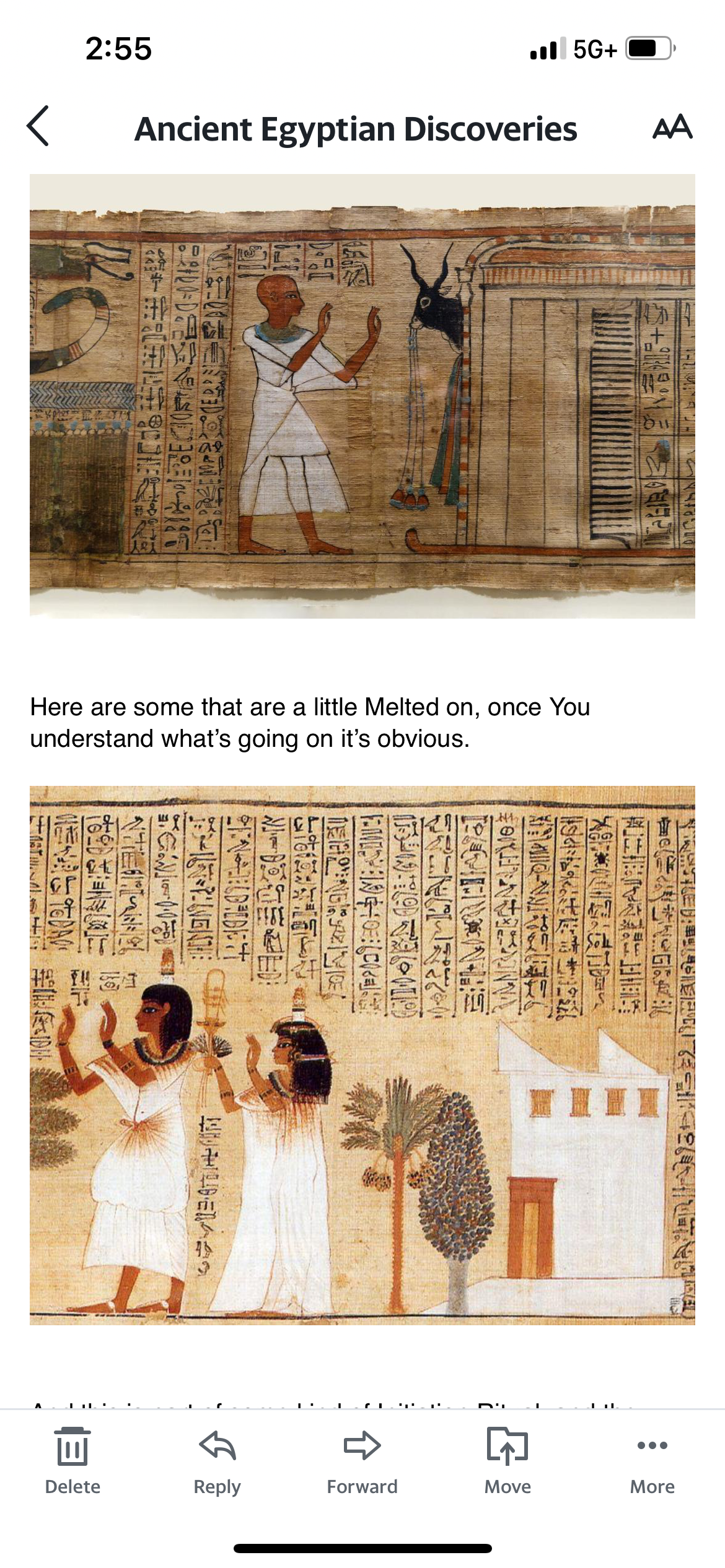
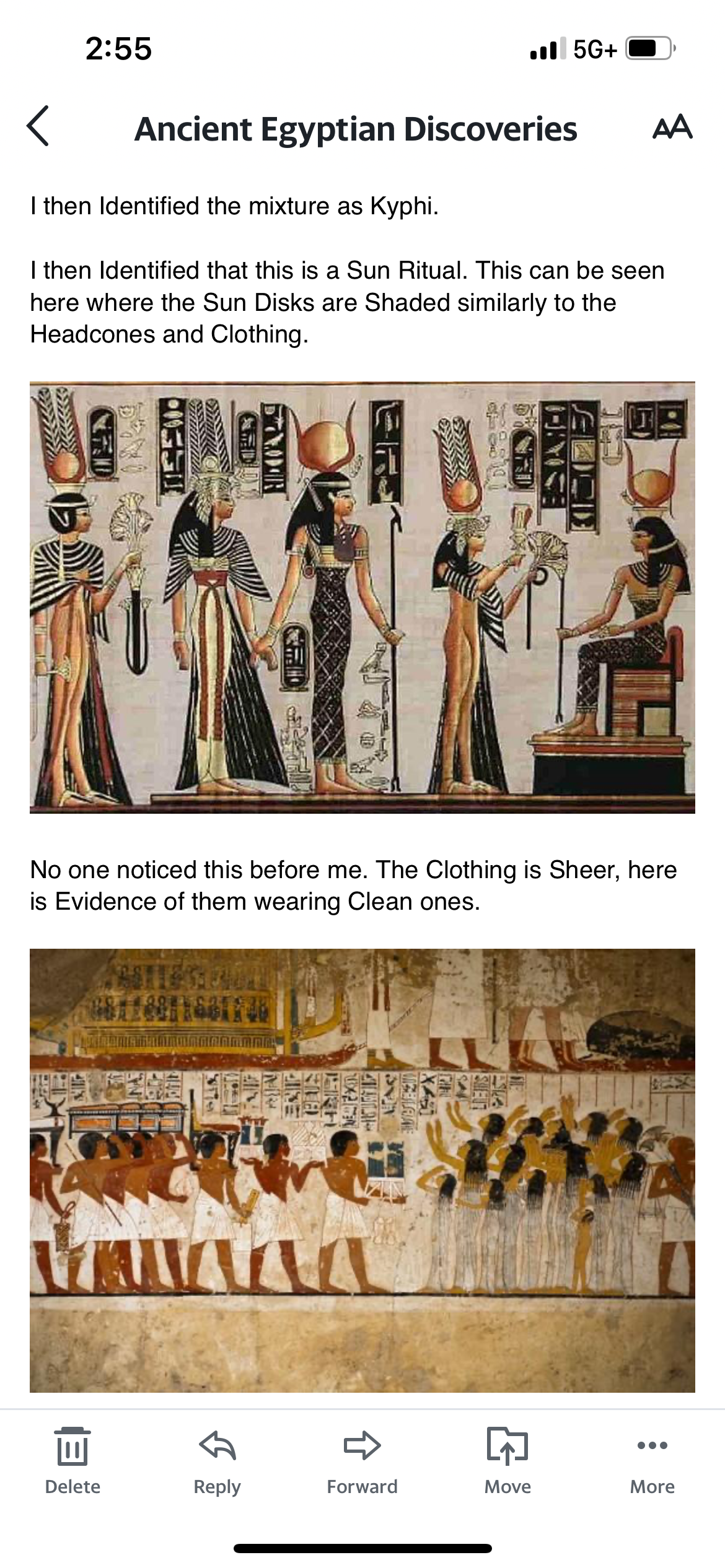
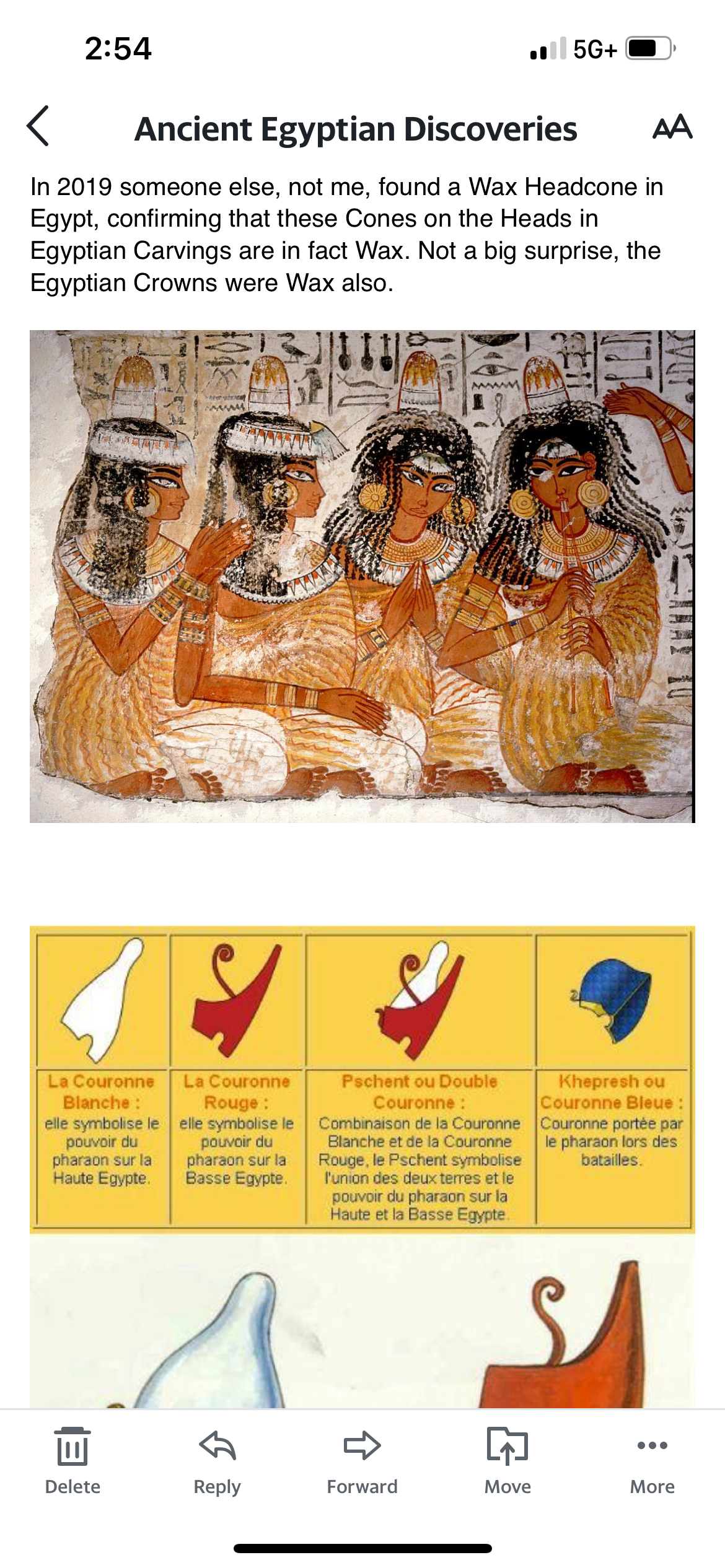
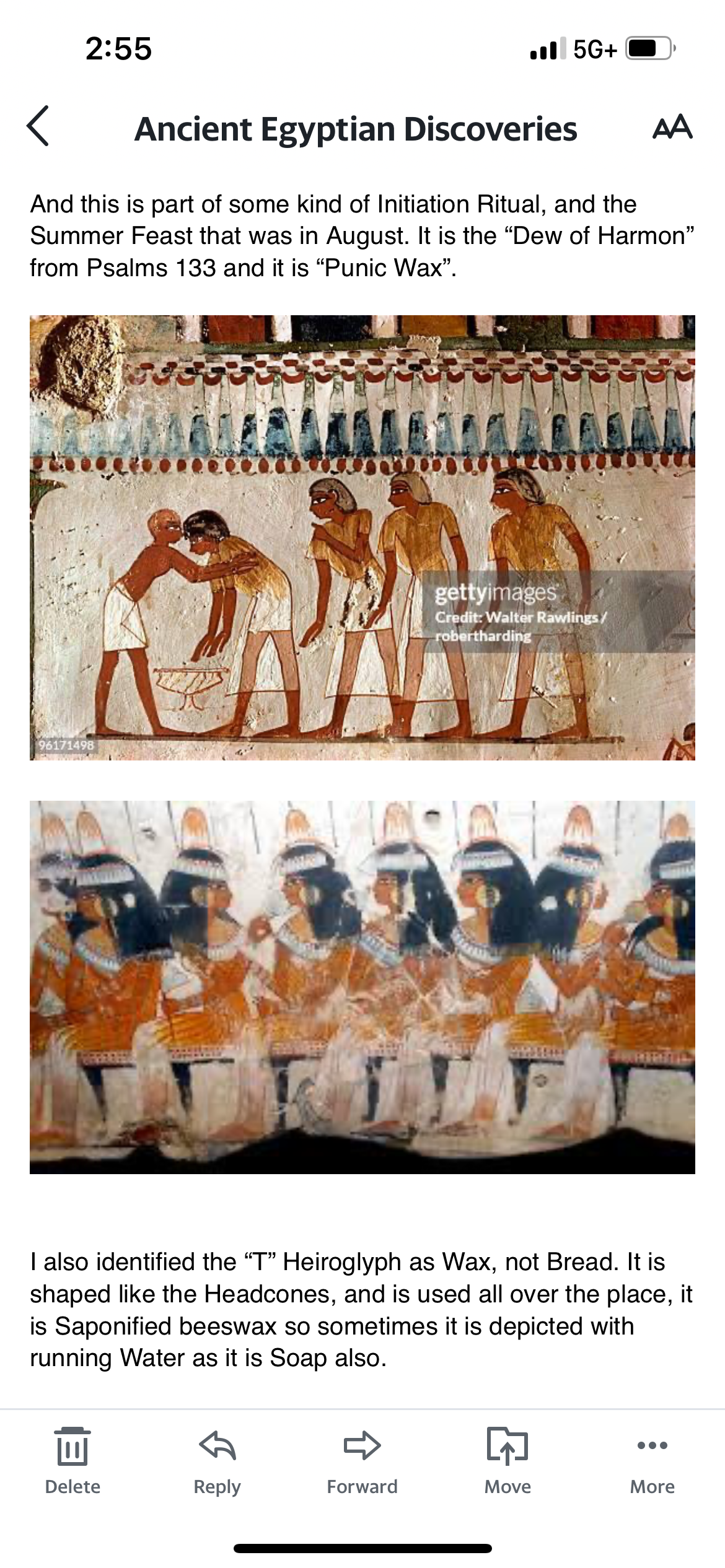
The wax headcone research this account has been developing separately belongs here too, at least as a thread to pull. Egyptian tomb art shows figures wearing cone-shaped objects on their heads for over a thousand years before archaeologists finally excavated two real ones at Amarna in 2010 and 2015 — beeswax, hollow, fabric-lined, published in Antiquity in December 2019. This research has argued, from the shading patterns in tomb paintings, that those cones were Kyphi-infused — Kyphi being Egypt's own incense-perfume-medicine, cinnamon and resin and wine-soaked fruit worked into wax — and that they were built to melt in direct sun exposure onto sheer linen clothing, turning a ritual into a slow-release transdermal application. That reading also lands on Psalms 133 — "the precious ointment upon the head, that ran down... as the dew of Hermon" — as a biblical echo of the same sun-and-wax technology, tied by this research to a summer feast that fell in August.
Set beside Vulcanalia, that's a second August fire-and-sun feast, from a second Mediterranean civilization, built around heat doing something deliberate to a sacred substance worn on the body. Whether that's a shared inheritance, a coincidence of climate and psalm-timing, or simply two cultures independently discovering that August sun is strong enough to melt wax, is exactly the kind of connection this account is inviting readers to sit with rather than resolve for them.
The Awareness
So: an actual holiday, older than the Republic, tied to the actual god the actual month sits closest to in myth, marked on August 23rd, still faintly alive in parts of Italy — and absent, completely, from the American calendar. No fireworks, no bonfire tradition ported over, nothing.
This post is the announcement. Light something on August 23rd. Hang cloth in the sun. Remember that a month can be renamed by a vote, a goddess can be installed by an oracle and a delegation, and a saint can quietly take over a god's old date — and that a forge-god's gift always arrives as both a blade and a breastplate at once. Vulcan's fire never got its American holiday. Consider this the opening bid.
#VanKushFamily · Melek.Salon · Dallas, Texas