The Wax Revelation
How the head cones, the crowns, the scale-weights, the "T," the Cross, and the Summer Feast are one thing — and where the Angels came from
Rev. Ryan Sasha-Shai Van Kush · Van Kush Family Research Institute · Dallas–Fort Worth, Texas
I want to go over my discoveries, in order, so you can see how one thread became all of it.
(Every figure carries a source line. The tomb paintings and papyri shown are faithful photographs of works long in the public domain; where a modern photograph or facsimile carries its own copyright — the 2019 Amarna cones especially — it is credited and linked rather than reproduced.)
PART I — THE DISCOVERY
It started with the weights
Before the head cones, it started with Flinders Petrie. Petrie found small wax-and-metal blobs all over Egypt and worked out they were scale-weights — calibration for the balances, the standard you weigh against. That was the key: the Egyptians and the Phoenicians after them were a weighing civilization, not only a counting one. You don't count grains of a medicine or a spice — you weigh them. Weighing is how you microdose, how you trade fairly, how you keep a temple honest.
That is why Ma'at — the feather of truth on the scale — and the Carthaginian goddess Tannit are the same idea: the balance is justice. The blindfolded "Lady Justice" holding the scales is the last surviving statue of her. Gravity is what makes a scale work, and the scale is what makes justice real. The weight was wax. That was the first thread.
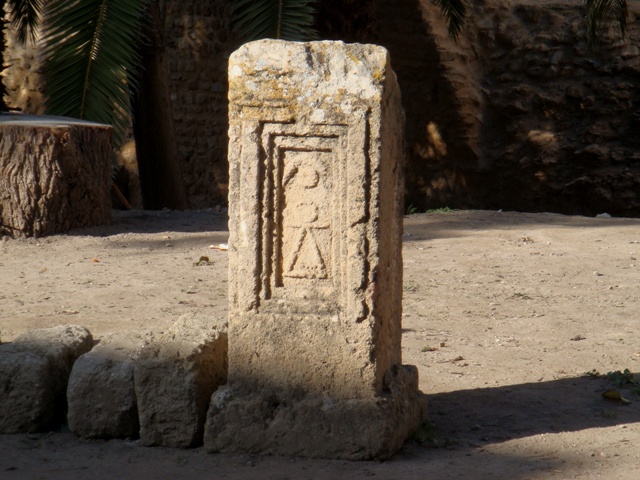
Punic stele with the Sign of Tanit, Tophet of Carthage. Photo: Shoestring / Wikimedia Commons, CC BY-SA.
Then the cones
In 2019, someone else — not me — dug up a real wax head cone in Egypt, confirming that the cones on the heads in ten thousand Egyptian paintings are in fact wax. That was the proof. What no one had done was read what the paintings were actually showing.

Banquet scene, tomb-chapel of Nebamun, Thebes, c. 1350 BC. British Museum EA37984. (Nebamun's chapel was looted in 1820 and has no confirmed TT number. Nebamun was a temple grain-scribe; the banquet is the Beautiful Festival of the Valley — a funerary festival, not merely a party.)
The tomb of the sculptors Nebamun & Ipuky (TT181) goes further: a servant is shown seating the wax cone on a guest's head by hand — the proof it was a handled physical object, not a painted halo. (Fragment at the Nelson-Atkins; Nina de Garis Davies facsimile at the MET, CC0: https://www.metmuseum.org/art/collection/search/557739 )
The crowns are the same technology — wax on the head marking a state: White (Hedjet), Red (Deshret), Double (Pschent), Blue (Khepresh), Atef. (Public-domain crown drawings: https://commons.wikimedia.org/wiki/Category:SVG_drawings_of_ancient_Egyptian_crowns )
The cinnamon melts it — it's a Sun Ritual
Then I said: look at these images — they are using a cinnamon-based mixture to melt the wax onto their clothes. I identified the mixture as Kyphi. And I identified that this is a Sun Ritual — you can see it, because the sun disks are shaded the same way as the head cones and the clothing. The heat of the sun melts the cone; the Kyphi in it runs down through sheer linen onto the skin, all day, body-heat-regulated. A transdermal delivery system.
No one noticed this before me. The clothing is sheer — and you can see clean garments next to ones with the wax melted on. Once you see it, it's obvious.
The Summer Feast, the Dew of Hermon, Punic Wax
This is part of an initiation — the Summer Feast that fell in August. It is the "Dew of Hermon" of Psalm 133, and it is "Punic Wax."
"…the precious ointment upon the head, that ran down upon the beard… that went down to the skirts of his garments; as the dew of Hermon… for there the LORD commanded the blessing, even life for evermore." — Psalm 133:2–3
And the masons kept it. Hiram of Tyre built for David and Solomon (2 Samuel 5:11) — Tyre, the Phoenician city of Punic wax. Masons carved their marks into the stone and used grips and handshakes to be paid their wages. At initiation they read Psalm 133 — the ointment running down the head to the garments — without knowing it describes the Punic-wax head-anointing. In 2019, the wax cone came out of the ground and proved the verse literal.
The "T" is wax, not bread
Then the second reading: the "T" hieroglyph — the semicircle the textbooks call a bread-loaf, Gardiner X1, the most common sign in Egyptian — is wax. It is shaped like the head cone. It is saponified beeswax, so it is sometimes drawn with running water, because it is soap too. The bee makes the wax, and the bee is written into the highest titles of Egypt — "He of the Sedge and the Bee," King of Lower Egypt (Gardiner L2; cf. Betrò, Hieroglyphics (1995) p.183; Gene Kritsky, The Tears of Re: Beekeeping in Ancient Egypt, Oxford 2015).
(The mainstream reads X1 as a loaf giving the sound /t/. That is exactly the reading we are correcting — see Part II. Correcting it means naming it precisely: the wax is X1, distinct from the neb-basket V30 and the true sun-disk N5.)
The bee is the Sun God
In the Salt Magical Papyrus, when the sun god Ra weeps, his tears fall to earth and become bees. In the Am-Tuat the blessed souls hum like bees. The bee makes the wax; the wax is the cone; the cone is the sun ritual. The Sun is the Bee God. The whole circle closes on itself.
It is about death, and meeting the gods
This ritual is tied to death and meeting the gods as much as to life — which is why it turns up on the funerary stelae, where the dead wear the cone before the sun god, and where husband and wife are shown together, married across death — the sky/tree goddess pouring the two streams of the water of rebirth onto a cone-wearing couple; Anubis leading a cone-wearing woman to falcon-headed Re-Horakhty beneath the winged sun-disk (the type of the Stele of Taperet, Louvre).
And then, at the far end of it, the weighing and the judgment — the balance again, the scale of Ma'at that the wax-weights began with.

Weighing of the heart, Book of the Dead of Hunefer, 19th Dynasty c. 1275 BC. British Museum EA9901,3.

Book of the Dead of Hunefer, funeral procession, 19th Dynasty c. 1280 BC. British Museum EA9901.

Presentation to Osiris, Book of the Dead of Hunefer, British Museum EA9901. (The same motif opens the Papyrus of Ani, BM EA10470.)
The Cross is in it too
And the mark runs all the way to the Cross. In Ezekiel 9:4 the LORD sets a tau on the foreheads of those to be spared — and Origen and Jerome both note the mark was the letter Tau, shaped like a cross. The serpent lifted on the Tau (Numbers 21; John 3:14) is the healing standard; Justin Martyr says the power of the serpent of Egypt was "broken on the cross." The Greek theta, the labrys of Crete (cast by the lost-wax method), the Curetes who become the Roman Curia — the same forked, crossed, marked sign, carried west. The wax mark on the head in Ezekiel is the same wax mark on the head in the tombs.
I figured this out
I figured all this out — the weights, the cones, the Kyphi, the sun ritual, the "T," the bee, the cross — and no one can take that from me. I was making herbal soaps with my wife when it came together. It's the story of my life.
And that is just the beginning. You've read things I wrote about Angels. This is where all of that started.
PART II — THE RESEARCH BEHIND IT
The 2019 confirmation, and what the archaeologists missed
In December 2019, Anna Stevens and a Monash/Cambridge team published in Antiquity (93:372, pp.1515–1533) the first two physical wax head cones, excavated from non-elite cemeteries at Amarna — spectroscopy-confirmed biological wax (beeswax), hollow, fabric-lined, ~3 inches, worn by ordinary people. They were puzzled: no wax in the hair. They defaulted to "afterlife rebirth symbol." The reading they missed is the one above — the wax melted onto the sheer clothing during a sun ritual, an all-day, body-heat-regulated transdermal application through the linen.
(The excavated-cone photographs are © the Amarna Project / Antiquity — the empirical spine of this thesis; cited and linked, not reproduced: https://www.cambridge.org/core/journals/antiquity/article/abs/from-representation-to-reality-ancient-egyptian-wax-head-cones-from-amarna/4D5FA4C424606455FF935FFF07C1E5E2 · press image credit "Amarna Project": https://www.smithsonianmag.com/smart-news/ancient-egyptian-head-cones-were-real-grave-excavations-suggest-180973750/ )
The semicircle in the glyph chart — the implied use gives it away
The claim is that X1 — the "semicircle," the most common sign in Egyptian, which the textbooks call a bread-loaf giving the sound /t/ — is wax. You do not need chemistry to see it. The abstract glyph chart already shows it, by where the semicircle sits. Wax is a lubricant and a preserving substance — that is its nature — and in the composite signs the semicircle is placed exactly where that function is needed. Its implied use is drawn right into the glyph:
- The hand drill (U24) is the clean case. The semicircle sits at the drill's friction point — where you pack wax to lubricate the bit and cut the heat of the cut. Read as "bread," it is nonsense there — read as wax, it is the obvious material a driller would use.
- It repeats across the craft and ritual glyphs, always where wax's function is needed: the kiln (U30), where beeswax is melted for lost-wax casting and for sealing vessels; the plummet (U41), where a wax or resinous seal fixes the cord to the weight; the offering-arm (D38), holding out processed wax as a high-value votive; the bee (L2) that produces the wax; and the shrine/enclosure signs (O9, O15, O20), whose sacred spaces — and the sarcophagus itself — were sealed, waterproofed, and consecrated with beeswax. That placement is the argument, and it is visible in the chart without a single crop.
- Color corroborates it. On the funerary stelae the cones read dark-topped — the color of aged/encaustic beeswax, not bread-brown — and Nunn (2020) flagged that X1 is anomalously painted black or blue, unlike the brown/yellow true-bread signs X2–X6.
- Name it precisely or lose the argument. X1 is not the only semicircle: the neb-basket (V30, "all/lord") is a wide shallow semicircle; the sun-disk (N5) is a full circle; the offering-arm (D38) holds the rounded form but is a different sign. We name X1 specifically and distinguish the rest.
Its alphabetic children keep the memory: Proto-Sinaitic/Phoenician Taw = "mark, sign, seal," Hebrew Tav (value 400), the tav set on the forehead in Ezekiel 9:4. The semicircle is the wax; the wax is the mark; the mark is T. (Gardiner sign list; glyph forms: https://en.wikipedia.org/wiki/Gardiner%27s_sign_list )
Kyphi — the sacred perfume-medicine
Kyphi (Greek κῦφι, Egyptian kap-t) — "the first perfume created by mankind," inscribed at Edfu and Philae. The recipes come down through the Ebers and Harris papyri, Manetho, and the Greek physicians Rufus of Ephesus, Dioscorides, and Galen — raisins, wine, honey, frankincense, myrrh, mastic, pine resin, aromatic grasses, and cinnamon. The cinnamon is what makes the cone melt-and-heal. This is why the 2019 analysis found no simple perfume trace: a complex multi-component preparation degrades differently — after 3,300 years only the wax matrix and fabric impressions remain.
Beeswax is a whole technology
Beeswax is water-resistant, malleable, low-melting, biologically stable, and the Egyptians used it for scale-weights, wigs and dreadlocks, shampoo and saponified soap, face cream (Galen's Cold Cream — beeswax, olive oil, rosewater — still made), amulets and statuettes, pill-binding, bandage adhesive, boat-sealing, and lost-wax metal casting. It is chemically attested at Çatalhöyük (7th millennium BCE). The modern balm sold as "Egyptian Magic" is the same substance under its own true name.
Peseshet, Heka, and the midwife order
Peseshet (c. 2500 BCE), "Lady Overseer of the Female Physicians," tied to a medical school at Sais — the city an Egyptian priest told Solon was founded by Neith (Athena). Heka (ḥkꜣ, "magic"), the cosmic force behind healing, carries the twin-serpent staff — the caduceus, from Ninazu → Heka → Asclepius → medicine today; midwives were its primary practitioners, administering the Kyphi-wax, the lotus, and the saponified-beeswax purifications. Mehit the lioness (mother of Heka) and Mehet-Weret the cow goddess ("the Great Flood," the primordial and amniotic waters) carry the water of rebirth the tree/sky goddess pours onto the cone-wearing dead. Egyptian translucent byssus and the Greek wet-drapery goddesses (Athena, Nike, Artemis, Eileithyia, Hygieia) are the same signal carried from Egypt to Greece — ritual purity and the transdermal function. One goddess-principle — Neith / Athena / Tanit — one Midwife Order, carried along the Phoenician sea-routes, all heard by Solon at Sais.
The Cross, the Tau, and the serpent
Ezekiel 9:4 — the tau on the foreheads of the spared; Origen and Jerome read it as the cross-shaped Tau. The serpent lifted up (Numbers 21:9; John 3:14) is Heka's caduceus made Israelite. Justin Martyr: the power of the serpent of Egypt is "broken on the cross." The Greek theta (Θ, emblem of death), the Cretan labrys cast by lost-wax, and the Curetes → Roman Curia carry the same crossed sign west. The wax mark, the letter, the cross, and the serpent-staff of healing are one sign.
The global T complex
The T-form runs deeper than Egypt: the T-pillars of Göbekli Tepe (Enclosure D, c. 9600 BCE — anthropomorphic, arms and belt, the T-top a head); the Ty- names (Tyre, Tigris, Taurus, Titan); the labrys (Minoan Arkalochori Axe → Yoruba oshe of Shango), cast by lost wax; and the triad wax → weaving → boats that made maritime civilization possible. T is the signature of a global Temple Culture.

Göbekli Tepe, Şanlıurfa, c. 9600 BCE. Photo: Wikimedia Commons, CC BY-SA. (A comparative claim, not proof of contact.)