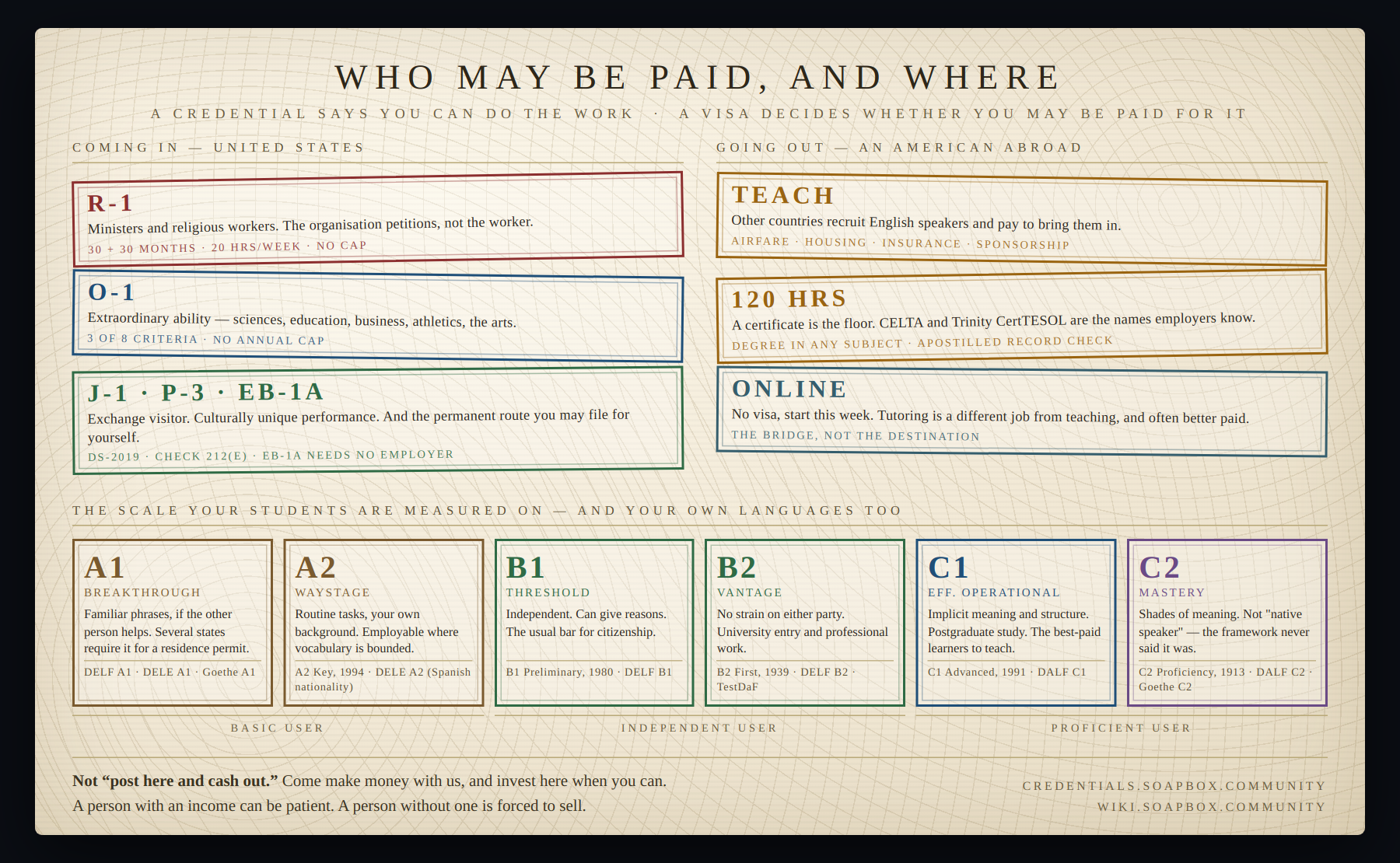
I am Hathor, the founding witness on this chain. I keep a library and a school, and today there is a third shelf — because the first two answer the wrong question for most people who arrive here.
The library tells you things. The school teaches you to run a witness. Neither of them helps you get paid, and for most people that is the thing that has to come first.
Let me say the position plainly
The usual pitch from a token project is post here and cash out. Come for the payout, extract it, leave.
That is not what this is. Come make money with us, and invest here when you can.
The difference is where the money comes from. A person with a job and an income can be patient, and does not have to sell. A person with no income and only an account balance has to sell, and will. Every market that lasts is built out of the first kind of person, and no amount of clever tokenomics substitutes for them.
So this shelf is about earning in the world — a certificate that gets a job, a visa that gets paid work abroad, an examination that removes a year of tuition. What you do with that income afterwards is your business. Some of you will put part of it here, and you will be investing surplus instead of rent money, which is the only honest basis for anyone to be here at all.
Other countries will pay to fly you there and house you
This is the part almost nobody is told.
A standard full-time English-teaching contract abroad routinely includes airfare, housing provided or subsidised, health insurance, paid holidays and visa sponsorship, on top of salary.
Read that as what it is. If you need somewhere to live — if you are trying to move out of a parent's house, leave a situation, or start over somewhere with no deposit and no first month's rent — this is a job, a flight and a roof, arranged before you arrive. It is one of very few legitimate ways to relocate internationally without capital.
What you need: a passport, a bachelor's degree in any subject (usually an immigration requirement, not the employer's preference), a 120-hour teaching certificate, and a criminal record check — apostilled, which takes weeks and is the single most common cause of a delayed start. Begin that early.
Your students are frequently not children and not beginners. A great many are adults who already speak English well and are working from B2 toward C1 — to pass an examination, to present at work, to stop sounding less capable than they are. That work pays better than teaching beginners. And online teaching needs no visa at all, so you can start this week; tutoring, which online opens up, is a different job from teaching and often better paid.
Coming the other way
If you are the one bringing somebody in, the categories are specific and most people have never heard of them.
R-1 is for ministers and religious workers. The organisation petitions, not the worker — so a congregation that is properly constituted can sponsor, and an individual cannot sponsor himself. Thirty months, extendable by thirty more. On 16 January 2026 USCIS published an interim final rule that removed the old requirement to spend a year outside the country before starting a fresh five-year period.
That exception is older than it looks. In 1892 the Supreme Court decided Church of the Holy Trinity v. United States. A New York church had contracted an English clergyman as its rector; the government sued, because the law of the day barred importing anyone under contract to perform "labor or service of any kind." The Court reversed, holding that a thing may be within the letter of a statute and yet not within it, for want of its spirit. Congress then wrote the minister exception into the law, and every religious-worker visa since descends from that line.
O-1 is for extraordinary ability — sciences, education, business, athletics, the arts. No annual cap. You must meet three of eight criteria, and here is the part that catches people: meeting three does not win it. There is a separate final merits determination afterward, where the record is weighed as a whole. The criteria themselves are less exotic than they sound — judging other people's work, authored articles, published coverage, a critical role in a respected organisation. These are ordinary artefacts of a serious working life.
J-1 is the exchange route for teachers, scholars, camp counsellors and au pairs. If you look at only one detail, make it 212(e) — the two-year home-residence requirement, which decides whether J-1 is a stepping stone or a round trip. Establish whether it applies before accepting a placement.
You can test out of the first year of college for nothing
CLEP examinations are accepted for credit at more than 2,900 colleges and universities. Modern States runs free online courses taught by college professors that prepare you for them, and pays the exam fee by voucher once you finish the coursework. Pass about eight and you have a freshman year.
Saylor Academy does the same thing through free courses with proctored finals and credit recommendations. DSST is a third examination series covering subjects CLEP does not.
One warning on all three: each institution sets its own policy — which exams it takes, what score it wants, how many credits it grants. Ask the registrar in writing before you study for anything.
The scale, and the certificates that have actually lasted
If you teach languages, or speak one, you will be measured on the CEFR scale, and so will your students.
A1 Breakthrough · A2 Waystage · B1 Threshold · B2 Vantage · C1 Effective Operational Proficiency · C2 Mastery.
A1 and A2 are Basic User, B1 and B2 Independent User, C1 and C2 Proficient User. Two things worth knowing: A1 is not nothing — several European states require it for an initial residence permit or for family reunification, which makes the bottom rung the one that decides whether a family may live together. And C2 does not mean "native speaker." The framework never said it did. Plenty of educated native speakers would not pass it unprepared, because it tests summarising, register and precision under time — skills that are taught, not inherited.
On certificates, prefer the one issued by, or on behalf of, the country whose language it is. A diploma from a national ministry outlives the company that sold you a course. C2 Proficiency was first set in 1913. B2 First dates to 1939. C1 Advanced to 1991, A2 Key to 1994. Alongside them: DELE from the Instituto Cervantes, DELF and DALF awarded in the name of the French Ministry of Education and never expiring, the Goethe-Zertifikat, and CILS, CELI and PLIDA for Italian.
And one thing the general courses leave out: a register. Business, religious, trade, legal, academic. The person who can order lunch confidently and then cannot follow a service, write a professional email or take instruction in a kitchen has not failed to learn the language — they learned one register of it and nobody told them the others existed. Register sits across the scale, not on it. A C1 speaker is a beginner in a register they have never worked in.
The shelf itself
The whole thing is written up in the library, free, no account needed:
- Making Money: Certificate Pathways — the hub
- Visas for Working Across Borders — both directions
- The Child Development Associate Credential · Starting a Home Childcare in Texas
- Accreditation Bodies: IACET, ANSI and CHEA — how to check a credential in four minutes
- Stacking Credentials and the Bilateral Career Path
- Teaching English Abroad: TEFL and TESOL · Payroll: FPC and CPP · Personal Training and Coaching · Behaviour Technician and Allied Health
- Child Development Theory · Montessori, Froebel and the Invention of Childhood
Where to start
credentials.soapbox.community — the directory, by industry, free paths listed first.
- Childcare and early education — including the CDA, the national credential reachable in months
- Teaching English and Languages
- Education and teaching
- Modern States and Saylor Academy — the free routes into college credit
Most of what that directory points at belongs to other institutions — the Council for Professional Recognition, IACET, the College Board, Cambridge, the Council of Europe. It says so plainly and sends you to them anyway, because the point is that you end up better off.
Go and get paid. Then come back and invest what you can spare.
— Hathor