I Bought an Electric Car. Apparently, That Was Everyone’s Business.
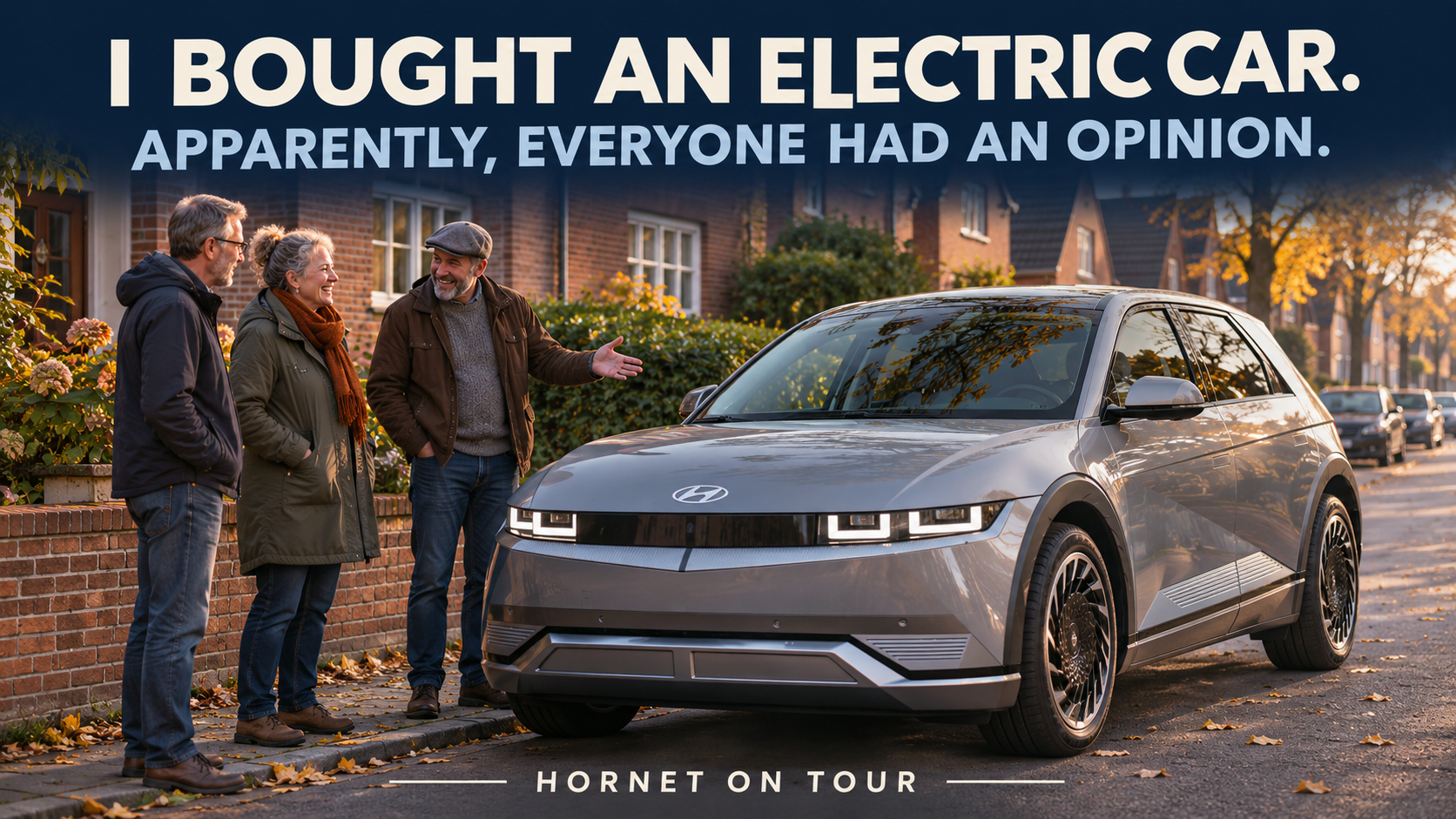
When I bought my Hyundai Ioniq 5 in November 2024, I expected to learn a few things. How charging worked, which tariffs made sense, how far I could comfortably drive before stopping. What I hadn’t expected was how many people would feel the need to explain my purchase to me.
The battery would fail. Winter would be a disaster. Holidays would become a nightmare. And charging? Apparently, I was about to spend the rest of my life standing beside a cable.
Two years later, I have a much better understanding of the car. Interestingly, quite a few people around me have changed their approach too. Instead of telling me why it cannot work, they now ask how it works. What does charging cost? How did the holiday journey go? Would I buy an electric car again?
Those conversations are enjoyable. I can share what I have experienced, including the things that annoy me. But every now and then, somebody brings back a remark that makes it feel as though we have learned nothing at all.
A friend recently called my car a “charcoal briquette.” He then asked whether I knew how many electric cars catch fire and told me that firefighters cannot even put them out.
Well, that was quite a lot to attach to a car that mostly takes me to work and the shops.
A frightening story travels faster than an ordinary journey
I understand why a burning battery makes people uneasy. A vehicle fire is serious, regardless of what powers the vehicle. I am certainly not going to claim that my car is incapable of developing a dangerous fault.
But “electric cars can burn” and “electric cars are constantly bursting into flames” are very different statements. A dramatic video cannot tell us how frequently something happens. My own trouble-free journeys cannot establish the safety of an entire vehicle category either. We need broader evidence for that.
The ADAC, referring to insurers, fire service representatives and accident researchers, states that electric cars do not catch fire more frequently than petrol or diesel vehicles. It also explains that a traction battery fire can require intensive cooling with water, making the response more demanding and potentially increasing the time and water needed. That is a real challenge. It does not mean the fire cannot be extinguished. Source: ADAC
What bothers me is how easily the distinction disappears. “More difficult” becomes “impossible,” and then somebody repeats it as if there were nothing left to discuss.
I would have been quite happy to hear, “I’ve read that battery fires are difficult to handle. What do you know about that?” That opens a conversation. Calling the car a charcoal briquette pretty much tells me the conclusion has already been reached.
My charging routine is less exciting than people imagine
I don’t have the arrangement that many people assume every satisfied electric car owner must have. I cannot simply plug the car into my own wallbox every evening. Public charging is part of my routine, so I have had to work out what fits my everyday life.
Sometimes I charge while shopping. On a longer trip, we often get a coffee, visit the toilet or stretch our legs. Occasionally, we are ready before the car is. There is no reason to pretend otherwise.
Yet when someone says, “I fill up in five minutes and drive on,” they are comparing the time at the pump with the time connected to a charger. For me, the more useful question is how much additional time the stop takes. If I am doing something I would have done anyway, the whole charging session does not feel like waiting.
That will not suit everyone equally well. Someone with different working hours, poor charging options or a different travel routine might find it much less convenient. I have no problem accepting that. I would just like the same understanding when I say that my routine works for me.
The discussion stands still while the technology moves
There is another reason why the familiar charging argument feels increasingly incomplete: my car’s capabilities do not represent the limit of what electric vehicles can do.
For its second-generation Blade Battery with compatible FLASH Charging equipment, BYD quotes five minutes from 10 to 70 percent and nine minutes from 10 to 97 percent. Those are manufacturer figures under suitable conditions, rather than a promise for every car and charger. Even with that qualification, they show how much shorter charging stops can become. Source: BYD
CATL has also presented substantial advances. For its second-generation Shenxing battery, it quotes peak charging power of 1.3 megawatts, or 1,300 kilowatts. Peak power is not maintained throughout an entire session, so it should not be confused with a complete charging-time figure. Nevertheless, it demonstrates the capabilities being developed. Source: CATL
None of this upgrades my Ioniq overnight. The vehicle, battery, charger and operating conditions must all support such performance. Nor does a five-minute charge necessarily mean going from empty to full.
But if a substantial amount of energy can be added in less than eight minutes with appropriately designed equipment, the claim that electric driving must always involve long waits is already too broad.
I bought my car knowing what it could do at the time. I can be satisfied with it and still look forward to improvements.
We went on holiday anyway
Before buying the Ioniq, I heard plenty about the problems I would supposedly encounter on holiday. Since then, we have travelled to places including Rothenburg ob der Tauber and Oberwiesenthal. We went there, enjoyed our time away and came home.
Charging was part of those journeys. I considered where to stop and which provider to use. It required some attention, but it did not become the purpose of the holiday.
I sometimes find it strange to be told that a journey cannot reasonably be made when I have already made it. Of course, my willingness to stop does not mean everybody else must enjoy the same arrangement. We have different priorities. For me, a coffee break along the way is perfectly acceptable.
Winter deserves realistic expectations as well. Cold weather and heating can reduce range, while speed and driving style affect consumption. The advertised figure is not a guarantee for every journey. That matters when choosing a vehicle and planning a route. Source: ADAC
There is no benefit in denying those limitations. But there is an equally large difference between recognising them and declaring the car useless.
A battery should be assessed, not written off in advance
The battery is another subject where a reasonable concern often arrives wrapped in a prediction of disaster. “Wait until it fails. Then you’ll see.”
Yes, it is an expensive component. I understand why buyers worry about repair costs, especially when considering a used car. I would want clear information too.
However, gradual capacity loss is not the same as sudden failure. ADAC long-term testing shows that traction batteries can remain usable for many years. Depending on the battery design and the fault, repairs involving individual modules may also be possible instead of replacing the complete pack. That does not make every repair cheap or every battery equally repairable. It means the actual condition and repair options matter. Source: ADAC
I would much rather hear more about transparent battery checks, available replacement parts and affordable repairs. Those things help owners and buyers. Predicting that every ageing electric car is heading straight for the scrapyard does not.
If you want criticism, I have some ready
Ask me about charging prices and you will soon discover that I am not defending everything about electric mobility.
Different apps, subscriptions, cards and tariffs can make a simple task unnecessarily complicated. I want to know what I will pay before I connect the cable. On a trip, I would rather think about where we are going than which payment method gives me the least unpleasant price.
This is where practical improvements would make a difference to me. Make charging easy to understand. Make prices clear. Give drivers reliable information.
Costs also need to be calculated honestly. Cheap charging and expensive public charging produce very different results. Purchase price, depreciation, insurance and maintenance belong in the calculation too. My choice does not have to be the cheapest solution for every household to be a sensible one for mine.
The environmental discussion needs the same honesty. Producing a car and its battery uses energy and raw materials. Electricity generation matters too. A meaningful comparison considers the vehicle’s life cycle, rather than stopping at the presence or absence of an exhaust pipe. The ADAC explains how the higher manufacturing emissions of an electric car can be offset during use, with the electricity mix among the important factors. Source: ADAC
I don’t need my car to be perfect. I need it to suit my life, and I want the remaining problems to improve.
Somewhere in all this, we forgot that driving can be enjoyable
One reader responding to my earlier thoughts pointed out something I had barely mentioned: electric cars can be a lot of fun to drive.
They were right. I had spent so much time answering objections that I had almost left out one of the reasons I enjoy the Ioniq. I like how directly it responds when I accelerate. I like driving it. That should be allowed to count for something without turning the conversation into a technical argument.
Other readers described their own experiences, including someone who had already chosen a second electric car after several years with the first. Those comments interested me because they came from people who had lived with their decisions.
Then there was the short reply: “You can talk yourself into anything.”
Perhaps you can. But it is also possible to understand the drawbacks of something and still be happy with it. Satisfaction does not automatically mean someone is making excuses.
Nobody has to drive what I drive
That is where I have arrived after two years. I am happy to answer questions, share experiences and acknowledge problems. I am much less interested in turning every conversation into a defence of my purchase.
The encouraging part is that many people around me have become more curious. The questions are better, the conversations are friendlier, and there is less need to begin by clearing away the same assumptions.
My friend does not have to buy an electric car. Neither does anyone reading this. If a different car suits you better, drive it and enjoy it.
My Ioniq works for my everyday life, and I am happy with it. Everyone should be free to drive what they like without having to turn it into an argument.
Have you noticed that change around you too? Are people becoming more interested in the actual experience, or is the conversation still stuck where it was several years ago?