An Unexpected Giant at the Charger 🚛⚡
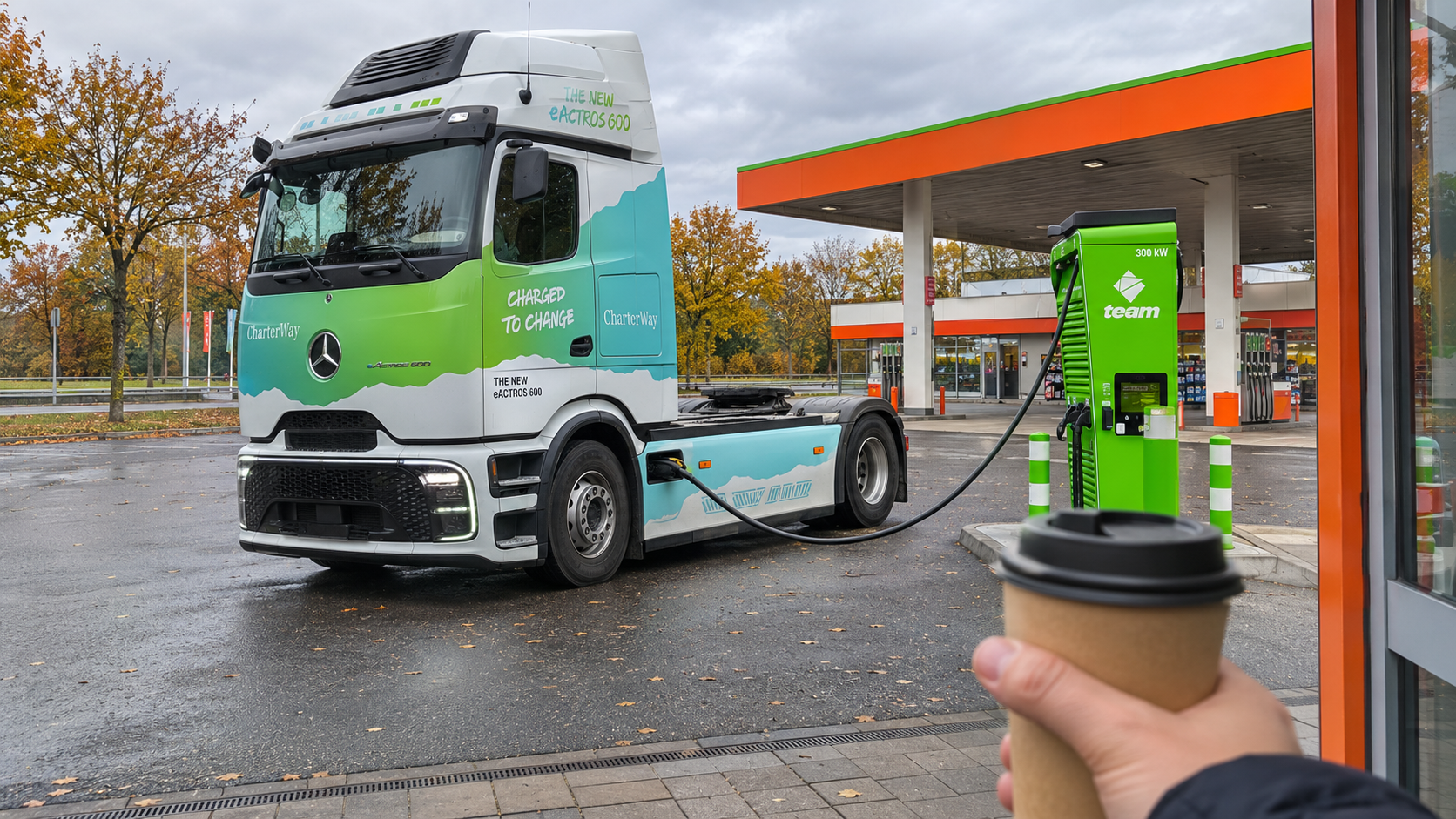
We left our Ioniq charging and went to get a coffee. When we came back, it had acquired a neighbour that was rather difficult to overlook.
“What’s that truck doing there?”
That was my first reaction. A second later, my brain caught up with my mouth: electric trucks exist too! 😂
When we arrived, we had the charging station entirely to ourselves. We plugged in our car, went into the petrol station to use the toilet and picked up a nice hot coffee. During that short break, a large tractor unit had pulled up at the chargers.
I knew about electric trucks, of course. But knowing they exist and suddenly finding one beside your own car are different experiences. Our Ioniq looked considerably smaller with that enormous cab next to it.
The lettering on the side identified our new neighbour as a Mercedes-Benz eActros 600, wearing a distinctive white, turquoise and green CharterWay livery.
When we reached the chargers, I saw the driver and said: “That’s a sight you’ll have to get used to!” 😄
He didn’t understand me because he didn’t speak German. While my attempt at conversation went nowhere, I noticed that he was having a problem of his own. He stood in front of the charging unit looking rather lost. Apparently, he wasn’t sure how to start charging.
The display was set to a language using Cyrillic letters. I couldn’t read the instructions either, but I knew how the charger worked. So I showed him the necessary steps.
Fortunately, that didn’t require a shared language. He was then able to plug the connector into his truck and get the charging session running.
We each had our own separate charging unit, by the way. Otherwise, we might have ended up sharing the available charging power. With a battery that size next door, I was quite happy for our Ioniq to keep its own charger! 😂
Naturally, the encounter made me curious about the truck’s specifications.
The eActros 600 carries three LFP battery packs with a combined installed capacity of 621 kWh. The “600” in its name refers to the battery capacity of more than 600 kilowatt-hours, rather than its horsepower.
Mercedes quotes a range of around 500 kilometres, depending on operating conditions. Load, terrain and weather affect an electric truck’s range, just as they affect our cars.
Its electric drive provides 400 kW of continuous power, equivalent to approximately 544 metric horsepower. Peak output reaches 600 kW, or roughly 816 metric horsepower. Standing beside that huge cab, those figures seem quite appropriate.
Through CCS, the truck supports charging at up to 400 kW. Under optimal conditions, charging from 20 to 80 percent takes approximately one hour. The charging unit in my photo was rated at 300 kW, so it couldn’t deliver the truck’s maximum supported CCS charging power. I didn’t check the actual power during his session.
(html comment removed: Insert your two original photographs here. )
What stayed with me most wasn’t the battery capacity or the power figures, though. It was how quickly my surprise turned into a practical encounter with another driver.
A moment earlier, I had been wondering what a truck was doing there. Then I was helping its driver operate the charger. We couldn’t have much of a conversation, but we could still solve the problem in front of us.
Our Ioniq was charging, the Mercedes was finally charging too, and we had our hot coffee. A perfectly ordinary stop—with an unusually large neighbour.
Next time I see an electric truck at a charger, I’ll hopefully skip that first confused question. I’ll probably still take a closer look, though. 😄
Have you seen an electric truck charging in public yet?
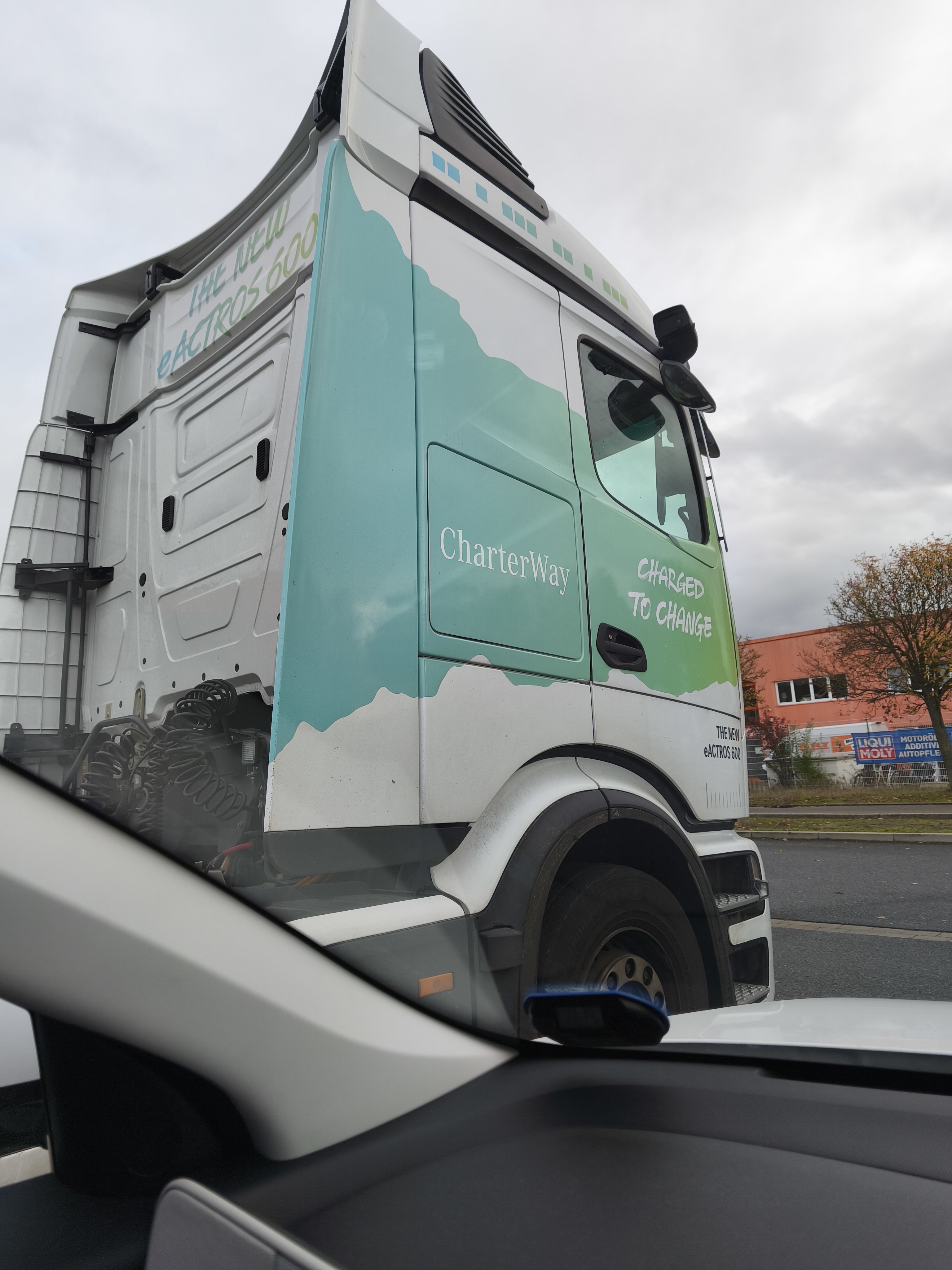
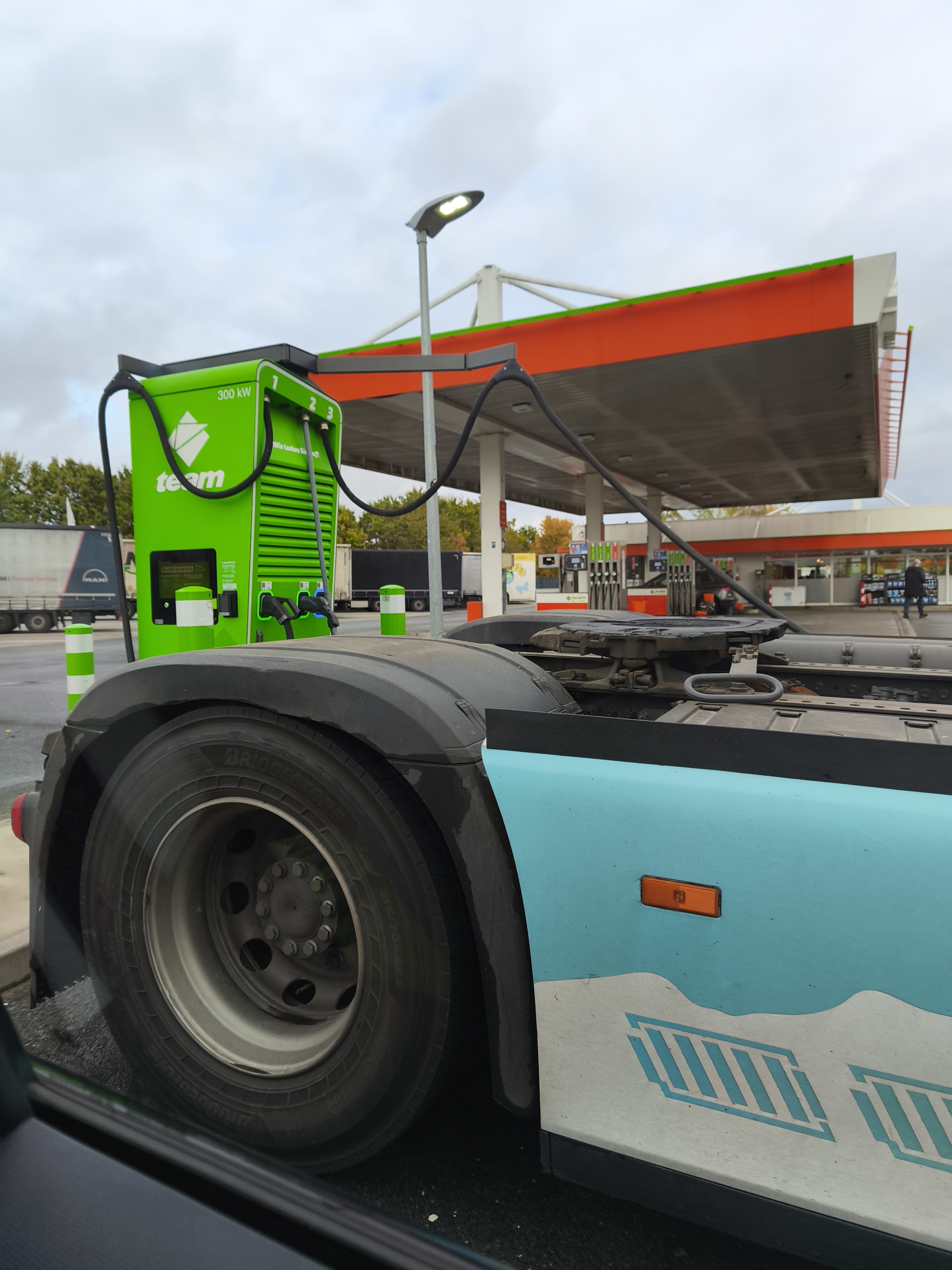
Technical information: Mercedes-Benz Trucks – eActros
Photographs: My own photographs
Cover image: Created with AI using my photographs as references